How U.S. cities are seeking to diversify their funding sources for housing assistance programs and eliminate barriers to housing construction.


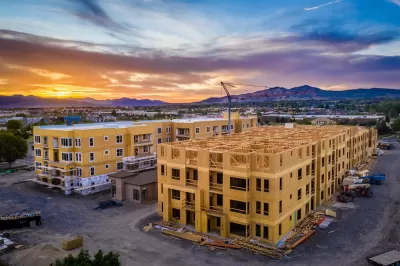
In an article for Smart Cities Dive, Kalena Thomhave outlines emerging trends in how cities approach reducing homelessness and alleviating the housing crisis, which continues to impact most American cities. “Just 34 affordable rentals are available for every 100 renters with extremely low income, according to the National Low Income Housing Coalition.”
As Thomhave notes, some cities are using their local power to reduce zoning restrictions on multifamily housing, enact tenant protection and rent stabilization laws, and outlaw discrimination against housing voucher recipients. “Alongside plans for the construction of permanent housing, cities are also building interim housing: safe, temporary housing for people experiencing homelessness.”
Cities are also looking for ways to reduce dependence on federal housing assistance programs. One such revenue source, the so-called “mansion tax” on transfers of high-value properties, was passed by over a dozen localities since 2018 and could become a significant source of new revenue for affordable housing programs.
Taking a different approach, some cities are taking more punitive measures against unhoused people after a Supreme Court ruling, Grants Pass v. Johnson, paved the way for the criminalization of homelessness.
FULL STORY: How cities could tackle homelessness in 2025


One Federal Low-Income Housing Program is Actually Being Expanded
Recent changes to the Low-Income Housing Tax Credit program could lead to over a million new housing units, but cuts to adjacent and complementary programs could limit its impact.

Michigan Capital's $640K ‘Pod’ Homes for Homeless Residents not Approved for Winter Use
Lansing officials approved a plan to purchase 50 modular micro-housing units as emergency shelter for the city’s unhoused residents.
January Must-Reads: Top 10 Articles From Last Month
How a tidal wave of potential changes at the federal level could throw many programs planners depend on into chaos, a roundup of last year’s zoning stories, and the continuing ripple effects of a landmark Supreme Court case.

Planetizen Federal Action Tracker
A weekly monitor of how Trump’s orders and actions are impacting planners and planning in America.

The state-sanctioned urbicide of Austin
People don’t kill cities. Freeways do.

US to reduce Colorado River water deliveries to Mexico
A new Colorado Treaty amendment reduces Mexico’s Colorado River water allocation by 250,000 acre feet.

5 New England states march closer to 800 megawatt wind energy project
Securing federal approval for the project may be complicated under the Trump administration, which has historically been hostile towards domestic wind power.

Baltimore to break ground on $50 million Transit Priority Project
The project will bring faster bus trips, safer streets and better bike connections to Baltimore.

Airbnb launches $250 million 'last-dollar financing' housing accelerator, makes first investment in Austin
The company will put $6.4 million towards affordable housing development in Texas’ capital.

FREE Course: Walkable City 1: Why Walkability?
After describing his path towards focusing on walkability as the essence of good planning, Jeff Speck marches through his five principal reasons for making more walkable places.
Reinventing Malls: Planning Alchemy—Turning Gray Fields Into Gold
The course focuses on the opportunities and imperatives that shape reinvention of mall sites.

Eagle County Government
Harvard University Graduate School of Design
Nashville Planning Department
The Architects Foundation
University of Cincinnati Online
The Pocatello Development Authority
The Urban Renewal Agency of the City of Pocatello
Journal of the American Planning Association