The National Trust for Historic Preservation publishes its 2004 list of America's 11 most endangered historic places.


Located in a remote part of Utah, Nine Mile Canyon, called 'the world's longest art gallery' for its 10,000 Native American rock-art images, is threatened by plans for extensive oil and gas exploration. Far away, in the oak and redwood-studded ranchlands of northern California, Ridgewood Ranch, Home of Seabiscuit, is in jeopardy, its former thoroughbred glory dulled by deterioration. In New York City, an unorthodox and controversial icon of the recent past, 2 Columbus Circle, located on the southwest corner of Central Park, may soon be stripped of its architectural integrity. And, a state known for its historic villages, winding back roads, spectacular mountain vistas and strong sense of community Vermont is once again besieged by the onslaught of big-box retail development.
Thanks to Chris Steins
Read the full story: 2004 list of America's 11 Most Endangered Historic Places


Planetizen Federal Action Tracker
A weekly monitor of how Trump’s orders and actions are impacting planners and planning in America.

‘Going backwards:’ Baltimore mayor, students rally against state's transit funding plan
Maryland's proposed six-year plan provides no funding for Baltimore’s BMORE bus program and reduces its road maintenance funding.
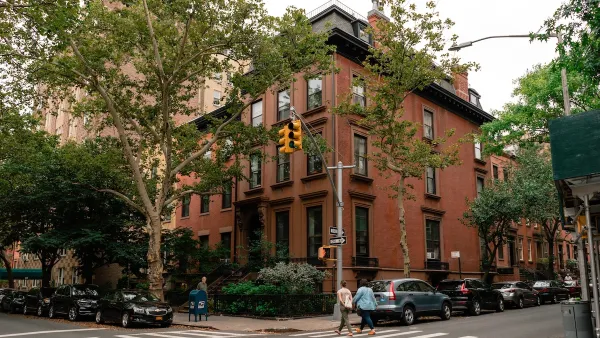
Mamdani sent nearly 6,000 pied-à-terre tax warnings to homes that didn’t qualify
A judge has ordered the administration to cancel thousands of pied-à-terre tax notices after it sent 35% of them erroneously.

A Colorado neighborhood is the testing ground for the future of home energy
A start up may have found a way to quickly bring geothermal energy to new communities.

Mamdani sent nearly 6,000 pied-à-terre tax warnings to homes that didn’t qualify
A judge has ordered the administration to cancel thousands of pied-à-terre tax notices after it sent 35% of them erroneously.

Detroit to transform waterfront with $2.2 billion investment
Developers will convert about 18 acres of unused parking lot space into civic spaces.

FREE Course: Walkable City 1: Why Walkability?
After describing his path towards focusing on walkability as the essence of good planning, Jeff Speck marches through his five principal reasons for making more walkable places.
Reinventing Malls: Planning Alchemy—Turning Gray Fields Into Gold
The course focuses on the opportunities and imperatives that shape reinvention of mall sites.

City of Thousand Oaks
City of Wisconsin Rapids
Harvard University Graduate School of Design
The Architects Foundation
University of Cincinnati Online
Northern Illinois Transit Authority (NITA)
The Pocatello Development Authority
The Urban Renewal Agency of the City of Pocatello