The decision invalidates a preliminary injunction that blocked two key housing bills.



The Montana Supreme Court reversed a decision by a judge last year that would have blocked two zoning reform bills, reports Blair Miller in the Daily Montanan. “The court found that Judge Mike Salvagni, a retired judge who was brought in for the case, incorrectly issued the preliminary injunction based on whether there was a ‘possibility’ of harm to the group and that it had only offered ‘generalized fears and supposition’ about the effects of Senate Bills 323 and 528,” Miller adds.
The court ruled that the claim did not meet four key factors required for a preliminary injunction: “that the applicant is likely to succeed on the merits; is likely to suffer irreparable harm absent preliminary relief; that the balance of equity tips in the applicant’s favor, and that the injunction is in the public interest.”
The bills, which call for cities to allow accessory dwelling units (ADUs) and duplexes on residential lots, were part of a major legislative package aimed at reforming outdated zoning laws and addressing the housing shortage that took effect on January 1 of this year. “SB 528 allows municipalities to allow accessory dwelling units on land that already has a single-family home, while SB 323 allows duplexes to be built in cities with populations of at least 5,000 people where single-family homes are allowed.”
Read the full story: Montana Supreme Court reverses judge’s decision that blocked residential zoning laws

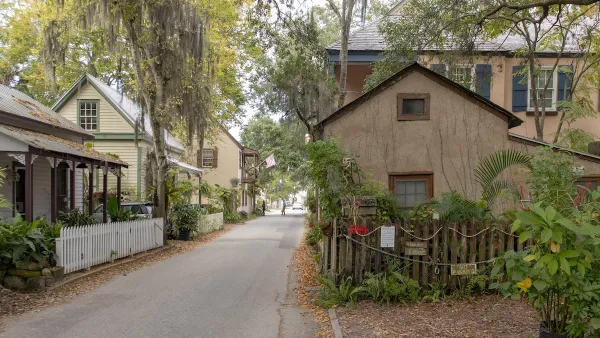
Florida Considers Legalizing ADUs
Current state law allows — but doesn’t require — cities to permit accessory dwelling units in single-family residential neighborhoods.

Experts Say Zoning Reform Isn’t Likely to Solve Housing Crisis
A survey by Fannie Mae found widespread skepticism among housing experts that zoning reforms will be enacted widely enough to make a major impact on U.S. housing supply.

Montana Judge Blocks Zoning Reforms
The decision reverses new laws once dubbed the ‘Montana Miracle.’

Planetizen Federal Action Tracker
A weekly monitor of how Trump’s orders and actions are impacting planners and planning in America.

California plans to bury El Niño’s downpour
If the state plays its cards right, it may be able to store a billion acre-feet of El Niño’s water in aquifers.

Desperate measures: Advocates weigh draining Lake Powell to fill Colorado River
Draining the reservoir could reduce evaporation losses by a couple hundred thousand acre-feet.

Chicago Avenue bridge construction delays enrages city leaders
The bridge has been closed since 2025. The city originally aimed to re-open it in December, and now expects to finish construction in 2027.

NYC bus network redesign speeds up Queens buses
Rush routes have seen a 4.6% speed increase after the redesign.

California High-Speed Rail Authority picks trainset manufacturer
The California High-Speed Rail Authority aims to start servicing passengers by 2033.

FREE Course: Walkable City 1: Why Walkability?
After describing his path towards focusing on walkability as the essence of good planning, Jeff Speck marches through his five principal reasons for making more walkable places.
Reinventing Malls: Planning Alchemy—Turning Gray Fields Into Gold
The course focuses on the opportunities and imperatives that shape reinvention of mall sites.

City of Rosemead
Rutgers University, Edward J. Bloustein School of Planning and Public Policy
One Hundred Miles
Hunter College, City University of New York (CUNY)
The Architects Foundation
University of Cincinnati Online
City of Cambridge
Montrose County
The Pocatello Development Authority