Multiple massive fires are burning across the Western United States and Canada, prompting governments to explore new mitigation and response strategies.


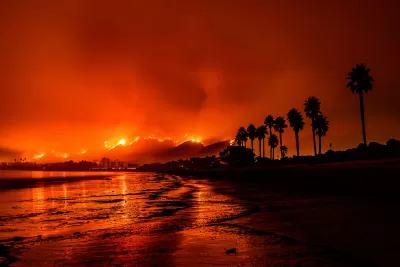
Wildfires are spreading across the West, straining firefighting resources and threatening communities across California, Oregon, and Canada.
According to a piece by Kiley Price in Inside Climate News, “The intense nature of these fires has made them extremely difficult to fight. In California, around 4,800 firefighters have been deployed to the Park Fire, but only around 14 percent is contained so far.” In Canada, the town of Jasper has been largely destroyed, displacing roughly 5,000 residents.
Price notes the economic damages of the fires, adding, “A forthcoming report by economic analysis group IMPLAN finds that wildfires could cost the U.S. economy nearly $90 billion this year, Heatmap News reports.”
The growing intensity of fires is causing government officials to explore new strategies for identifying risks, preventing major fires through prescribed burns, and responding to fires quickly and effectively. “In June, NOAA tested two experimental tools that use satellites and artificial intelligence to more rapidly identify fires and communicate information to land managers so they can deploy forces to fight the blazes before they spread.” Prescribed burns and brush clearing, practiced by indigenous people for centuries, are once again becoming key tools in wildfire management.
Read the full story: Supercharged by Climate Change, Western Megafires Explode Simultaneously
Climate Change Spurs Need for Better Fire Management
Controlling fire has never been a strong suit for humans. Now, as climate change sets in, the need for better fire management is becoming dire, according to researchers.

UCLA Experts Offer Critical Support for LA Wildfire Response and Recovery
The UCLA Luskin Center for Innovation offers expert guidance on LA wildfire response and recovery, addressing critical issues like water safety, air quality, equitable rebuilding, and climate adaptation to promote resilience and sustainability.
New Yorkers Face New Climate Risks
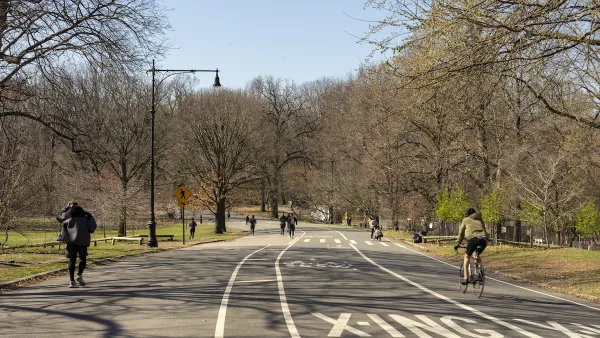
A two-acre fire in a city park prompted city officials to ban grilling while urging residents to conserve water to limit the impact of a historic drought.

Planetizen Federal Action Tracker
A weekly monitor of how Trump’s orders and actions are impacting planners and planning in America.

Eastern Nebraska is running out of electricity
Data centers and electrification are straining eastern Nebraska’s grid, throttling economic development.

Study reveals best places in the U.S. for cycling, walking
New research from Streetlight Data examines bicycle and pedestrian miles per capita in the 100 largest U.S. cities by population.

Next-generation nuclear reactors are coming to Texas
The reactors will not require towering containment structures thanks to new safety features.

California distributes $1.3 billion to prevent transit service cuts, bolster projects
Twenty-eight projects across California received a portion of the funding.

Pennsylvania Democrats have 15 affordability, clean energy bills for flipped state Senate
Bills in consideration include a bill supporting geothermal energy and a bill supporting solar on warehouses.

FREE Course: Walkable City 1: Why Walkability?
After describing his path towards focusing on walkability as the essence of good planning, Jeff Speck marches through his five principal reasons for making more walkable places.
Reinventing Malls: Planning Alchemy—Turning Gray Fields Into Gold
The course focuses on the opportunities and imperatives that shape reinvention of mall sites.

City of Charlotte
City of Rosemead
Rutgers University, Edward J. Bloustein School of Planning and Public Policy
University of Michigan School for Environment and Sustainability (SEAS)
Hunter College, City University of New York (CUNY)
The Architects Foundation
City of Cambridge
The Pocatello Development Authority
The Urban Renewal Agency of the City of Pocatello