A “Planners’ Pledge” created by some of the leading authorities on planning sets forth a bold urbanist agenda- even if not every idea in the pledge is equally useful in all cities.


When I attended the Congress for New Urbanism (CNU) conference last year, Jeff Speck spoke eloquently about the idea of a “Planners’ Pledge.” Planners could sign the pledge to commit to more environmentally friendly, walkable development.
The Pledge is now public, and it is signed by some of the most eminent authorities on urban policy, including people who I have known for decades such as Emily Talen and Scott Bernstein, as well as newer voices like Peter Norton, Diana Lind, and Angie Schmitt. Naturally, the Pledge has much to recommend it — but also includes some ideas I am not so enthusiastic about.
The Pledge begins with an explanatory section, pointing out that “planners have contributed to the creation of a landscape that separates us ruthlessly both from different activities … such that we are inordinately connected to our automobiles and less connected to one another.” The Pledge then contains a set of “whereas” clauses elaborating on this idea, thirty concepts that planners should encourage, and fifteen that planners should discourage.
Most of the “encourage/discourage” policies are exactly what I would have expected from New Urbanists. For example, the Pledge endorses encouraging more housing in walkable areas and dense development near public transit, while suggesting that highway construction and car-dependent places should be discouraged. Although I agree with these goals, I was especially heartened by the Pledge’s emphasis on street design, an area that might have gotten less coverage before the growth of car crash deaths in the 2010s and 2020s. Rather than merely throwing on a few platitudes about Vision Zero, the Pledge urges that roads be limited to a design speed “no higher than the desired vehicle speed” and sizing “firefighting equipment to fit community streets and not vice versa” (in other words, narrower streets). More broadly, the Pledge urges planners to discourage the creation of new streets that do not “safely welcome pedestrians and cyclists” and to oppose the use of environmental review that stalls pedestrian and cyclist facilities.
On the other hand, the Pledge does have a few ideas that seem dated to me. The Pledge contains too many platitudes about community engagement for my taste, stating that planners should encourage a “fully inclusive community planning process” and discourage the “creation of any neighborhood plan without first engaging the local community.” It seems to me that this emphasis on community planning may have made more sense a few decades ago when housing supply and housing costs were not nationwide problems.
But today, it seems clear to me that the interests of an individual neighborhood (let alone the interests of the tiny fraction of neighborhood residents who attend planning-related meetings) are often not the interests of the broader city, region, or planet. It may be rational for each neighborhood to want to preserve the status quo. For example, even if planners inform a wealthy neighborhood’s residents that new housing might not lead to an influx of poor people or traffic, the residents might understandably be afraid of taking a chance. But if every neighborhood stops or slows down the healthier changes endorsed by the Pledge, no housing gets built, and people priced out of existing housing may be forced to move to automobile-dependent suburbia.
The Pledge also encourages planners to support inclusionary zoning. Inclusionary zoning (requiring developers to set aside a certain percentage of apartments for unprofitable, lower-income housing) makes sense if you think developers can afford to build unprofitable apartments and still make a healthy profit. But this idea seems less plausible now than it did a couple of decades ago: rising land costs, rising construction costs, rising taxes, and rising insurance costs have made all forms of development less profitable in many places. It follows that burdening developers with an additional tax (in the form of unprofitable apartments) seems likely to reduce housing supply.*
The Pledge comes down strongly on the side of historic preservation, urging planners to discourage the “destruction of any significant sidewalk-facing building façade more than 100 years old.” This restriction seems to me quite sensible in newer cities such as Orlando, where such buildings are either rare or concentrated in a small number of historic neighborhoods. But in older cities like mine, there are many, many such buildings, so preserving of all of them would make the creation of new homes and apartments far more difficult than in Orlando. Some of the older cities with the most pre-1925 buildings are also the cities with the best public transit (such as New York). So freezing older buildings in place seems to me a bit inconsistent with the Pledge’s goal of transit-oriented development.
On balance, I certainly find at least 80 percent of the Pledge appealing. But I suspect that if it was written by planners younger than myself, or maybe just planners with more market-oriented views, it would be a bit different.
*For a much more detailed discussion I recommend this post.

March Must-Reads: Top 10 Articles From Last Month
Seattle may roll back a development fee as housing permits plummet, an ambitious Google-led project in the heart of San Jose goes sideways, and a list of sci-fi books to feed your futurist dreams.

Planetizen’s Top Urban Planning Books of 2024
Top of mind in 2024 were the far-reaching impacts of climate displacement, zoning as a solution to the housing crisis, and the potential for safer roads and better public transit in American cities.
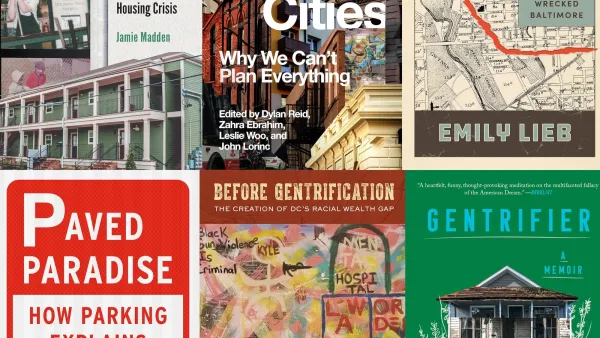
10 great urban planning summer reads
Wherever you're going (or staying) this summer, here are some suggestions for books to bring along.

Planetizen Federal Action Tracker
A weekly monitor of how Trump’s orders and actions are impacting planners and planning in America.

Amtrak, CN end decades-long dispute with eight-year agreement
The new operating agreement establishes an updated framework for the companies to work together, including processes to resolve disputes.

Northwest rail fans eager for Sept. 30 debut of Amtrak’s Airo fleet
Get ready for that new train smell and more seats. But they won’t go faster or run more frequently on the Cascades route in Washington and Oregon.

Brightline Florida files for bankruptcy
The transit company is over $5 billion in debt.

St. Louis Metro to test if single-car trains can reduce operating costs, maintain rider satisfaction
The pilot program will run from October to spring 2027, and begin with one single-car train operating on Metrolink’s Red and Blue lines.

Pennsylvania is building data centers in abandoned mines
Housing data centers in mines provides an alternative to destroying local forests and may spare residents from data centers’ noise and air pollution.

FREE Course: Walkable City 1: Why Walkability?
After describing his path towards focusing on walkability as the essence of good planning, Jeff Speck marches through his five principal reasons for making more walkable places.
Reinventing Malls: Planning Alchemy—Turning Gray Fields Into Gold
The course focuses on the opportunities and imperatives that shape reinvention of mall sites.

City of Thousand Oaks
City of Wisconsin Rapids
Harvard University Graduate School of Design
The Architects Foundation
University of Cincinnati Online
The Pocatello Development Authority
The Urban Renewal Agency of the City of Pocatello

