In addition to reducing emissions, the agency officials hope the climate action plan will help increase ridership and boost their competitiveness when applying for federal transit funding.



The Pittsburgh Regional Transit agency has set a goal to reach net zero carbon emissions by 2045 as part of the city’s first climate action plan, according to 90.5 WESA, Pittsburgh’s NPR news station. “The agency plans to reduce the 104.5 million tons of carbon emissions it produces each year by expanding its electric bus fleet, purchasing light rail cars that use less electricity and switching to solar power to run their buildings,” writes Julia Fraser. It also aims to get more people to ride buses, both to reduce emissions and to keep their transit system solvent.
Increasing ridership is an ambitious goal, as transit ridership in both Pittsburgh and across the country dipped when the pandemic hit and has been slow to rebound. “Pittsburgh’s ridership only rebounded back to 64% of its pre-pandemic level for that week. And so far this year, fewer Pittsburghers have taken transit than in 2023, according to Pittsburgh Regional Transit data,” Fraser reports.
Buses are the biggest source of emissions for the agency and therefore the area where it can make the biggest impact. But with only nine electric buses (and 14 more on the way, according to the article) out of a fleet of 729 diesel vehicles, it will be a while before they reach their 100 percent electric goal, particularly given the challenges installing charging infrastructure and retraining mechanics, as well as growing pains the electric bus industry has faced lately. The city is also looking into hydrogen-cell-fueled buses as an alternative. It will also be expensive, as the agency already faces a “fiscal cliff” as federal pandemic relief money comes to an end this year. But just having a climate plan enables the agency to go after more money and stay competitive for current funding, Derek Dauphin, director of planning and service development at Pittsburgh Regional Transit, told 90.5 WESA.
FULL STORY: Pittsburgh Regional Transit climate plan aims to increase ridership, reduce emissions

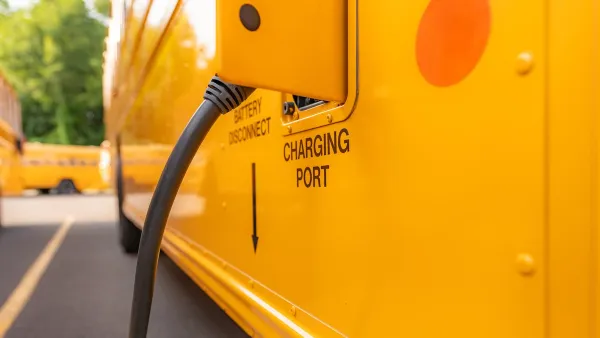
Pittsburgh Rolls Out Electric School Buses
Pittsburgh Public Schools has launched its first electric school buses, with plans to fully electrify its fleet over the next 14 months, aiming to create a cleaner, more sustainable transportation system supported by new charging infrastructure.

Assessing Prince George's County's Climate Action Plan
The Prince George's County draft Climate Action Plan includes ambitious goals and timetables, but falls short of recommended targets for emissions reductions in the transportation sector.

Boise Aims to Go Carbon-Neutral by 2050, Adopts New Climate Plan
City leaders expressed enthusiastic support for the Climate Action Roadmap, a detailed plan for reducing carbon emissions, protecting the environment, and meeting other climate goals.

Planetizen Federal Action Tracker
A weekly monitor of how Trump’s orders and actions are impacting planners and planning in America.

The state-sanctioned urbicide of Austin
People don’t kill cities. Freeways do.

US to reduce Colorado River water deliveries to Mexico
A new Colorado Treaty amendment reduces Mexico’s Colorado River water allocation by 250,000 acre feet.

5 New England states march closer to 800 megawatt wind energy project
Securing federal approval for the project may be complicated under the Trump administration, which has historically been hostile towards domestic wind power.

Baltimore to break ground on $50 million Transit Priority Project
The project will bring faster bus trips, safer streets and better bike connections to Baltimore.

Airbnb launches $250 million 'last-dollar financing' housing accelerator, makes first investment in Austin
The company will put $6.4 million towards affordable housing development in Texas’ capital.

FREE Course: Walkable City 1: Why Walkability?
After describing his path towards focusing on walkability as the essence of good planning, Jeff Speck marches through his five principal reasons for making more walkable places.
Reinventing Malls: Planning Alchemy—Turning Gray Fields Into Gold
The course focuses on the opportunities and imperatives that shape reinvention of mall sites.

Eagle County Government
Harvard University Graduate School of Design
Nashville Planning Department
The Architects Foundation
University of Cincinnati Online
The Pocatello Development Authority
The Urban Renewal Agency of the City of Pocatello
Journal of the American Planning Association