With discussions centering on how to solve the housing crisis and create more equitable communities, Minneapolis is a fitting host city for APA’s annual National Planning Conference.



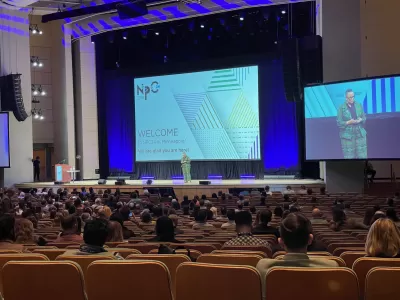
The 2024 National Planning Conference (NPC) kicked off on Saturday in Minneapolis, with major themes around the housing crisis and diversity, equity, and inclusion. These topics felt particularly fitting, given the fact that the conference’s host city was the first in the nation to eliminate single family zoning in a bid to not only increase the diversity of housing options throughout the city but also the diversity of people in all of its neighborhoods.
Full transparency: I have been to many NPCs in my time, though it’s been a few years. However, this was my first time as an attendee rather than a staffer of the American Planning Association (I was on Planning magazine’s editorial staff from 2014 to 2022). It was both an exciting and surprisingly overwhelming experience, mainly because I had such a hard time choosing between sessions to attend! But in the end, I was not disappointed.
Opening session set the tone
The morning started with the opening session, which featured a welcome by Minneapolis’s mayor, Jacob Frey, who spoke about the city’s history of segregation — first overtly by racial covenants and redlining and then covertly (after the passage of the Fair Housing Act in 1968) through zoning — and how the city’s zoning reform sought to change that. As a result, Minneapolis has kept rents and home prices down more than any other city in the country, he said.
Then came talks from APA CEO Joel Albizo, who talked about APA’s focus on foresight and upskilling to prepare planners for challenges and opportunities, like AI and other disruptive technology, the future will bring. “We can’t predict the future, but we can look toward it and plan for it,” he said. Next, Angela D. Brooks, FAICP — APA’s first Black female president — spoke of the wonderful work of the AICP and the APA Planning Foundation to build the profession’s credibility and provide scholarships to the urban planners of tomorrow.
Brooks then introduced the keynote speaker, Lori Pace, urban planner and CEO of Changing Paces. Pace referenced how Bob Marley pioneered reggae by blending many different types of influences and drew on her Jamaican roots to discuss how to build understanding among different people and unite on common interests by recognizing the humanity in each other, holding each other accountable, and challenging one another. It was an inspiring message that set a great tone for the rest of the day.
Housing Supply Accelerator
There was a lot of buzz about the Housing Supply Accelerator partnership session, which I got a chance to attend, though the room was nearly full. It featured a panel about the partnership between APA, the National League of Cities, the National Homebuilders Association, and the National Association of Realtors. Moderated by APA CEO Joel Albizo, the panel featured Angela Brooks, FAICP, APA president and director of the Illinois Corporation for Supportive Housing; Corey Woods, mayor of Tempe, Arizona; and Carl Harris, a custom home builder and NAHB first vice chairman.
The panelists had a frank discussion about potential solutions, policy recommendations, and their perspectives on the housing crisis and the challenges faced by cities and planners. Brooks pointed out, “It is not just in a national housing crisis, but an international housing crisis. It’s everywhere.” In the name of facilitating speedy, innovative housing solutions, she encouraged planners to look at how they can “get out of the way and prevent an adversarial relationship with developers.”
NAHB’s Harris agreed, saying, “If we don’t start working on these changes today, then the American Dream is in jeopardy,” and added that a collaborative partnership between builders and planners is essential. “We need each other to tackle this problem.”
Tempe Mayor Woods echoed Harris’s sentiment regarding planners being a vital part of the equation. He said planning is not in public officials’ backgrounds, so they depend on planners to help educate them with quality information and data to help them make the best decisions for their communities.
Equity discussions and next steps
Another theme threaded throughout the conference was equity, diversity, and inclusion (DEI). There was a lot of buzz in particular about the annual Equity Forum, the first of which happened at a National Planning Conference 20 years ago. I was extremely disappointed I wasn’t able to catch it; however, my fellow conference goers informed me it was an excellent discussion.
I was able to attend two other valuable sessions: “Equity, Diversity, and Inclusion Across Conservative Landscapes” and “Real-World Applications for APA Equity Guides.” Overall I got the sense that APA and the urban planning profession as a whole has acknowledged the crucial role of DEI in our communities and how its absence negatively and disproportionately impacts Black, Indigenous, and people of color, as well as the lasting and still-present harm of discriminatory land use practices and policies. It took a lot of time, effort, persistence, and advocacy of BIPOC planners and allies to get to this point.
Now the discussion seems to be shifting to how to keep this momentum into the implementation stage. The key question moving forward is how can planners codify DEI values and principles into planning policies and practices to ensure all of these efforts have lasting impact — but without leading to gentrification and displacement, particularly in BIPOC neighborhoods. It’s an exciting yet daunting challenge, especially for planners in conservative states where under the current political climate all things DEI are receiving major pushback.
Final note
If you want to learn a bit more about NPC24’s host city, check out Planetizen’s new City Profile for Minneapolis, which gives a high-level overview of the city and its history through a purely urban planning lens, including key planning milestones.

The 2019 National Planning Conference Is Underway
Couldn't make it to San Francisco for the 2019 National Planning Conference? Live vicariously through the magic of the Internet.

Trends from the APA 2015 Conference
Every year we analyze all of the tweets from the APA Conference and tell you about the trends in planning. With 2,884 people tweeting from the APA Conference, there is a lot of great ideas, links, and pictures that we can all learn from.
Celebrating APA's 2015 National Planning Awards Recipients
A highlight of the APA's National Planning Conference every year—the presentation of the National Planning Excellence and Achievement Awards.

Planetizen Federal Action Tracker
A weekly monitor of how Trump’s orders and actions are impacting planners and planning in America.

California plans to bury El Niño’s downpour
If the state plays its cards right, it may be able to store a billion acre-feet of El Niño’s water in aquifers.

Desperate measures: Advocates weigh draining Lake Powell to fill Colorado River
Draining the reservoir could reduce evaporation losses by a couple hundred thousand acre-feet.

Los Angeles just elected an urban planner as its mayor
Transportation analysts are optimistic that Raman will be more aggressive in addressing transit issues than Bass.

Mamdani’s pied-à-terre tax survives legal challenge
A panel of judges found that the plaintiffs failed to demonstrate injury as a result of New York City's implementation of the tax.

Eastern Nebraska is running out of electricity
Data centers and electrification are straining eastern Nebraska’s grid, throttling economic development.

FREE Course: Walkable City 1: Why Walkability?
After describing his path towards focusing on walkability as the essence of good planning, Jeff Speck marches through his five principal reasons for making more walkable places.
Reinventing Malls: Planning Alchemy—Turning Gray Fields Into Gold
The course focuses on the opportunities and imperatives that shape reinvention of mall sites.

City of Rosemead
Rutgers University, Edward J. Bloustein School of Planning and Public Policy
One Hundred Miles
University of Michigan School for Environment and Sustainability (SEAS)
Hunter College, City University of New York (CUNY)
The Architects Foundation
City of Cambridge
Montrose County
The Pocatello Development Authority

