Contrary to some arguments, public transit networks with higher government subsidies have higher ridership and more farebox revenue.


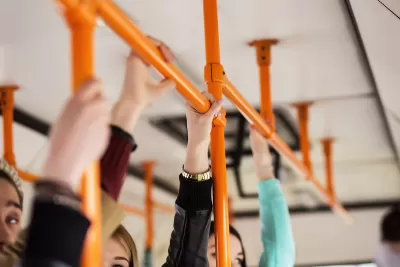
New research indicates that publicly subsidized transit systems are more efficient, writes Kea Wilson in Streetsblog USA. Regions with the highest subsidies also generate the most revenue from fares.
In a fascinating recent analysis, researchers found that metro areas that received more government subsidies per capita were more likely to run buses and trains with lots of passengers on board, rather than running inefficient, wasteful routes with just a few heavily subsidized riders per vehicle.
The analysis debunks the common argument that government subsidies fail to improve transit systems. According to the researchers, other studies often fail to account for regional transit networks that utilize more than one agency. “Instead, the new study looks at the simple ratio between how many miles transit passengers in the region collectively travel and how many miles transit vehicles in that region collectively travel, giving a clear, easy-to-understand picture of how crowded (or empty) subsided buses and trains are likely to be.”
The study shows that government subsidies for transit “seem to provide a strong foundation for transit networks to thrive — and ultimately, make significantly more money at the farebox than they would without support.”
FULL STORY: Study: Subsidizing Transit Actually Makes It More Efficient

Maryland Could Cut Transit Funding, Citing Budget Gap
The governor says the state remains committed to its major transit projects, but may need to reduce service to meet a growing financial shortfall.
Opinion: Microtransit Isn’t the Answer to Transit Woes
On-demand services can’t scale successfully without massive government subsidies, and could obscure the impacts of car-centric sprawl.
Opinion: How to Save D.C. Transit
Ridership data shows that many D.C. transit users depend on the service, despite a drop in ridership. The system needs changes—and funding—to have a future.

The state-sanctioned urbicide of Austin
People don’t kill cities. Freeways do.

US to reduce Colorado River water deliveries to Mexico
A new Colorado Treaty amendment reduces Mexico’s Colorado River water allocation by 250,000 acre feet.

New Jersey’s second-largest city bans standalone data centers
Jersey City will continue to allow co-location facilities, such as those meant for research institutions that store their own data.

Amtrak not solely to blame for New Jersey commuter rail's unreliability, report finds
A new study from the Garden State Initiative found that NJ Transit’s budget grew 20% across a 4 year period, but reliability declined significantly over the same period.

EPA erases limits on planet-warming pollution from power plants
Under Monday’s plan, power plants would still have some limits on how much mercury, arsenic and other contaminants they can emit.

Phoenix announces new on-demand transit service, more frequent RAPID buses
Both new services will launch in October, and are part of Phoenix's Project Effective Access Solutions for Easing Congestion.

FREE Course: Walkable City 1: Why Walkability?
After describing his path towards focusing on walkability as the essence of good planning, Jeff Speck marches through his five principal reasons for making more walkable places.
Reinventing Malls: Planning Alchemy—Turning Gray Fields Into Gold
The course focuses on the opportunities and imperatives that shape reinvention of mall sites.

Eagle County Government
Harvard University Graduate School of Design
Nashville Planning Department
The Architects Foundation
University of Cincinnati Online
The Pocatello Development Authority
The Urban Renewal Agency of the City of Pocatello
Journal of the American Planning Association