Building more housing near transit can improve housing affordability and boost ridership on struggling systems.



A proposed federal law would promote transit-oriented development and prioritize funding for jurisdictions that adopt ‘pro-housing policies’ such as eliminating parking minimums and clearing the way for multifamily construction by reducing minimum lot sizes and raising height limits.
As M. Nolan Gray explains in Bloomberg CityLab, the Build More Housing Near Transit Act of 2023 is designed to promote growth and density in areas near light rail and other transit lines by altering scoring measures for the federal New Starts grant program. “Rapid transit depends on dense clusters of housing and jobs near stations to draw in riders. Yet according to research by Ian Carlton, of MapCraft and ECOnorthwest, just over a third of the 412 transit stations funded through New Starts since 2009 were built in areas with half the prevailing regional density — typically around eight dwelling units per acre.”
Tying transit and housing more closely together would bring benefits for both. “With ridership still below pre-pandemic levels in many US cities, such transit-oriented development isn’t just important for housing affordability — it could also lock in many hundreds of thousands of new riders, bailing out cash-strapped transit agencies.”
Read the full story: Want More Transit (and Federal Funding)? Build Housing That Supports It

LA Metro Opposes TOD Law, Fearing Backlash to Transit Expansion
Metro wants an exemption from California’s new housing law, despite the law’s potential to increase ridership by putting more housing near transit stations.
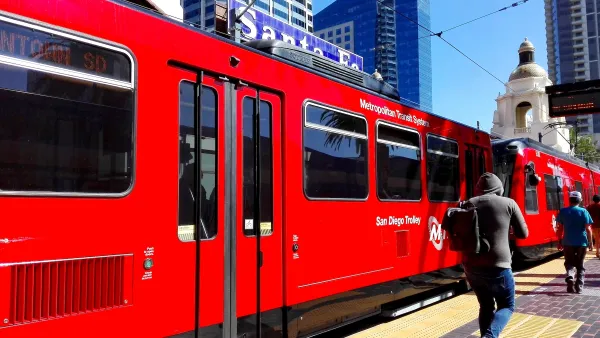
San Diego wants to limit upzoning law to just 16% of transit-adjacent parcels
The city's planning director says some areas are unfit for immediate upzoning due to a lack of resources or hazards such as wildfire risk.

High Housing Costs Driving Down Transit Ridership in LA
When neighborhoods gentrify and displace lower-income residents, transit ridership suffers, new research shows.

Planetizen Federal Action Tracker
A weekly monitor of how Trump’s orders and actions are impacting planners and planning in America.

California plans to bury El Niño’s downpour
If the state plays its cards right, it may be able to store a billion acre-feet of El Niño’s water in aquifers.

Desperate measures: Advocates weigh draining Lake Powell to fill Colorado River
Draining the reservoir could reduce evaporation losses by a couple hundred thousand acre-feet.

Post election, Texas is no longer Musk’s 'AI oasis'
Elon Musk dolled out $446 million on the 2026 midterms, the most ever spent by a non-canidate.

Chicago voters approve permanent festival grounds, penalty for vacant property owners
Currently, major summer and fall festivals take over public parks for weeks at a time, drawing criticism from nearby residents

NYC votes to cut outdoor dining red tape, speed up permitting
New York City also voted to allow the Department of Transportation to begin work on urgent projects before notifying elected officials.

FREE Course: Walkable City 1: Why Walkability?
After describing his path towards focusing on walkability as the essence of good planning, Jeff Speck marches through his five principal reasons for making more walkable places.
Reinventing Malls: Planning Alchemy—Turning Gray Fields Into Gold
The course focuses on the opportunities and imperatives that shape reinvention of mall sites.

City of Rosemead
Rutgers University, Edward J. Bloustein School of Planning and Public Policy
One Hundred Miles
Hunter College, City University of New York (CUNY)
The Architects Foundation
University of Cincinnati Online
City of Cambridge
Montrose County
The Pocatello Development Authority