New research suggests that cooling pavement treatments can actually make pedestrians standing on it feel hotter.


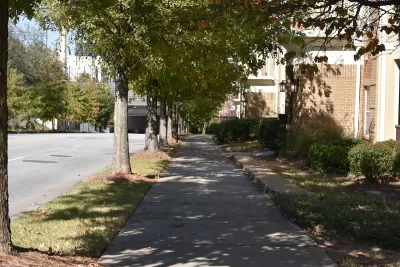
A popular new tool for cooling urban streets and sidewalks could have some unintended consequences, reports Linda Poon in Bloomberg CityLab. According to Poon’s article, “recent research in Phoenix has resurfaced a glaring tradeoff: The reflective coating can make pedestrians standing on the treated pavement feel even hotter.”
“When [professor V. Kelly Turner] and researchers at Arizona State University looked at the impacts of the first US program in Los Angeles, they found that around noon on a hot, dry day, a person standing on cool pavement could feel more than 7 degrees warmer than if they were to stand on uncoated asphalt. The mean radiant temperature, which is a measure of how humans experience the heat, fell in the afternoon but was still 3 degrees warmer.”
Those findings were reaffirmed by an Arizona State University study. However, Poon notes that “ASU’s study suggested minimal difference in mean radiant temperatures between sidewalks near traditional asphalt streets and those near reflective pavement,” meaning pedestrians walking on surfaces near coated streets but not directly on coated surfaces wouldn’t be affected.
For Turner, this points to a need to prioritize shade trees, a proven solution to urban heat, before trying more experimental solutions. But cooling pavement treatments have their place. By dramatically reducing surface temperatures, cool pavements can prevent burn injuries. “Perhaps a more pronounced effect of cool pavement technology that further appeals to cities is that it decreases thermal strain on the pavement, reducing cracking and helping extend its lifespan.” And one pavement treatment used in the Pacoima neighborhood of Los Angeles is showing promising results, with early research indicating that the treatment cools ambient temperature and doesn’t create glare in the same way as others.
Until more data on cool pavement coatings is available, experts believe cities should “carefully consider where to apply [them], and weigh both the costs and benefits alongside other interventions.”
Read the full story: The Hottest Urban Heat Solution Comes With a Glaring Tradeoff

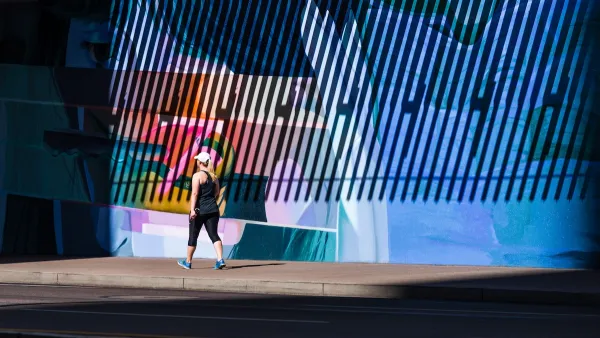
Research Shows Cool Pavement Coatings Can Raise Ambient Temperature
Coatings that reflect heat can make the air feel warmer for people standing on and around these surfaces.
Copenhagen is losing its cool
In a city long designed to maximize light during dark Scandinavian winters, climate change is forcing the Danish capital to rethink its relationship with the sun.
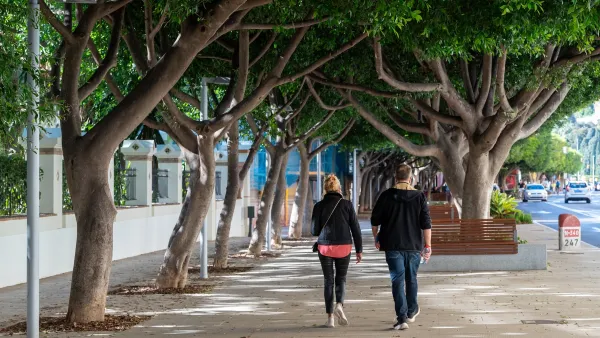
Green blocks are up to 4 degrees cooler than treeless streets
The difference in temperature created by urban trees can translate to as much as 40% less excess heat.

Planetizen Federal Action Tracker
A weekly monitor of how Trump’s orders and actions are impacting planners and planning in America.

Colorado’s Largest Data Center Could Rise Next to Homes — Without a Public Hearing
The proposed campus would consume 11 times the power of Denver International Airport; as it has across the country, opposition mounts.

US to reduce Colorado River water deliveries to Mexico
A new Colorado Treaty amendment reduces Mexico’s Colorado River water allocation by 250,000 acre feet.

'This is going to be painful:’ Virginia stares down $1.7 billion funding gap for highway maintenance
The state may address the deficit by shifting $290 million from its construction budget to maintenance projects.

Judges permit Denver to divert 77,000 acre feet from the Colorado River for reservoir expansion
Overuse and climate change have caused the Colorado River’s water levels to plummet.

Amtrak, CN end decades-long dispute with eight-year agreement
The new operating agreement establishes an updated framework for the companies to work together, including processes to resolve disputes.

FREE Course: Walkable City 1: Why Walkability?
After describing his path towards focusing on walkability as the essence of good planning, Jeff Speck marches through his five principal reasons for making more walkable places.
Reinventing Malls: Planning Alchemy—Turning Gray Fields Into Gold
The course focuses on the opportunities and imperatives that shape reinvention of mall sites.

KFH Group Inc.
Greater Baltimore Committee
Eagle County Government
The Architects Foundation
University of Cincinnati Online
The Pocatello Development Authority
The Urban Renewal Agency of the City of Pocatello