The city denies that the timing of clearing a camp populated by unhoused residents was related to the upcoming MLB All-Star Game.


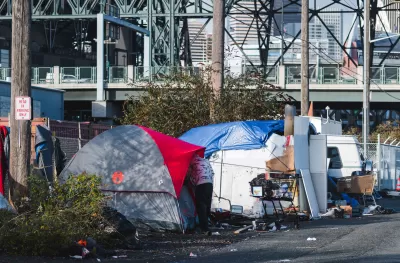
Last week, streets around Seattle’s T-Mobile Park, playing host to the MLB All-Star Game this week, became suspiciously empty of the unhoused people, tents, and RVs that usually line the sidewalks. “In their place, concrete blocks and ‘No Parking’ signs prohibit vehicles from parking there until July 11, the day of the All-Star Game.”
As Greg Kim reports in The Seattle Times, “A spokesperson for the mayor’s office said the city has focused much of its encampment removal efforts in Sodo over the past year and a half based on an ‘objective prioritization matrix’ that ranks Sodo highly due to the high concentration of RVs and tents in the neighborhood.”
The city has announced plans to open a safe parking lot in August which could hold 26 RVs, “a far cry from addressing the thousands of people estimated to be living in vehicles in King County.”
FULL STORY: Seattle clears large encampment in Sodo, denies timing with All-Star Game

Seattle mayor pledges to build 500 shelter units by June
The Seattle Times editorial board expresses cautious optimism about the mayor's ambitious supportive housing plan.
Grants Pass Homelessness Ruling Brings Issues Into Sharp Focus
Advocates for unhoused people are rallying to protect homeless populations as new legislation criminalizing homelessness rolls out around the country.
Evaluating D.C.’s Plan to House Encampment Residents
One year into a pilot program to reduce encampments by offering housing and services to residents, almost three-quarters of participants have moved into housing.

Planetizen Federal Action Tracker
A weekly monitor of how Trump’s orders and actions are impacting planners and planning in America.

The state-sanctioned urbicide of Austin
People don’t kill cities. Freeways do.

US to reduce Colorado River water deliveries to Mexico
A new Colorado Treaty amendment reduces Mexico’s Colorado River water allocation by 250,000 acre feet.

5 New England states march closer to 800 megawatt wind energy project
Securing federal approval for the project may be complicated under the Trump administration, which has historically been hostile towards domestic wind power.

Baltimore to break ground on $50 million Transit Priority Project
The project will bring faster bus trips, safer streets and better bike connections to Baltimore.

Airbnb launches $250 million 'last-dollar financing' housing accelerator, makes first investment in Austin
The company will put $6.4 million towards affordable housing development in Texas’ capital.

FREE Course: Walkable City 1: Why Walkability?
After describing his path towards focusing on walkability as the essence of good planning, Jeff Speck marches through his five principal reasons for making more walkable places.
Reinventing Malls: Planning Alchemy—Turning Gray Fields Into Gold
The course focuses on the opportunities and imperatives that shape reinvention of mall sites.

Eagle County Government
Harvard University Graduate School of Design
Nashville Planning Department
The Architects Foundation
University of Cincinnati Online
The Pocatello Development Authority
The Urban Renewal Agency of the City of Pocatello
Journal of the American Planning Association