The Chinese American Museum in L.A. currently features an exhibit exploring the drink’s journey from the cassava root in South America, to the tapioca balls in the Taiwanese confection, and back to the U.S. as a symbol of Asian American identity.



Boba tea or bubble tea is a tea-based drink that originated in Taiwan in the early 1980s. Taiwanese immigrants brought it to the U.S. in the 1990s, initially in California through regions like Los Angeles County, but the drink has also spread to other countries where there is a large East Asian population. Bubble tea most commonly consists of tea accompanied by chewy tapioca balls ("boba" or "pearls"), but it can be made with other toppings as well, such as grass jelly, aloe vera, red bean, or popping boba.
In this article, Janaya Williams writes about a new exhibit at the Chinese American Museum in Los Angeles called “the boba show: history, diaspora, & a third space” which explores the drink’s journey from the cassava root native to South America, to the tapioca balls in the Taiwanese confection, and back across the ocean to the U.S., where has also become a symbol of identity and culture for Asian Americans. Cal State University, Los Angeles Assistant Professor of Asian American Studies Juily Phun is the exhibit’s co-curator. She shares that boba helped young Asian Americans like her find a community in Southern California areas like the San Gabriel Valley.
Symbolically housed in the oldest and last surviving structure of Los Angeles’ original Chinatown, the Chinese American Museum embodies a cultural and physical link to the past, as well as a promising point of entry for the city’s multicultural future. Opened in December 2003 after 20 years of dedicated community and civic leadership and support, CAM’s presence at El Pueblo de Los Angeles Historical Monument—a 44-acre public park honored as Los Angeles’ “birthplace” and the site of its original Chinatown—reflects the vibrant development of an immigrant history that began over 150 years ago when the first major Chinese settlement was documented in Los Angeles.
Read the full story: Communi-tea: Boba is more than a drink at SoCal art show

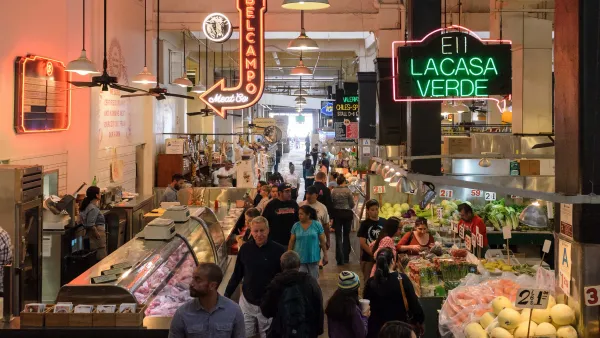
L.A.'s Grand Central Market at a Turning Point, Faces Gentrification
The historic Grand Central Market has ridden the ups and downs of Downtown Los Angeles better than most retail locations, but can it retain its heart in the face of gentrification.

LA needs $2 billion in Olympic Games transportation funding by Sept. 1, officials say
Congresspeople who serve the Los Angeles area met on Aug. 26 to urge the Trump administration to speed up funding.
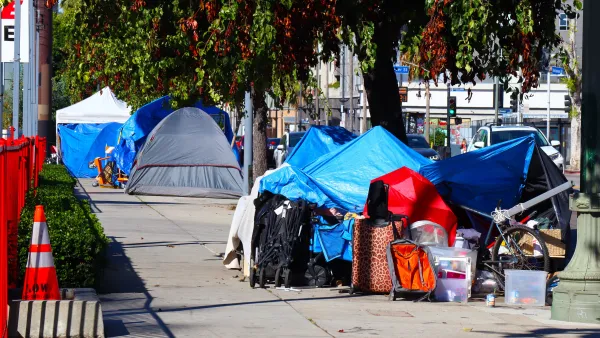
Los Angeles rescinds twelve 'anti-camping zones'
The zones previously prohibited unhoused people from camping in parts of Hollywood.

Planetizen Federal Action Tracker
A weekly monitor of how Trump’s orders and actions are impacting planners and planning in America.

The state-sanctioned urbicide of Austin
People don’t kill cities. Freeways do.

US to reduce Colorado River water deliveries to Mexico
A new Colorado Treaty amendment reduces Mexico’s Colorado River water allocation by 250,000 acre feet.

Nation's most wind-powered state turns to coal as data centers increase energy demand
For the first time in decades, Iowa has increased its generation of coal power.

NYC cools commuters with city's first rain garden above a bus stop
New York City officials say the plants in the rain garden can absorb 16 gallons of rainwater during heavy storms.

Brightline West’s future may rely on $6 billion federal loan
The company has until Nov. 2 to make a $400 million equity investment into its proposed high-speed rail line.

FREE Course: Walkable City 1: Why Walkability?
After describing his path towards focusing on walkability as the essence of good planning, Jeff Speck marches through his five principal reasons for making more walkable places.
Reinventing Malls: Planning Alchemy—Turning Gray Fields Into Gold
The course focuses on the opportunities and imperatives that shape reinvention of mall sites.

Greater Baltimore Committee
Eagle County Government
Harvard University Graduate School of Design
The Architects Foundation
University of Cincinnati Online
The Pocatello Development Authority
The Urban Renewal Agency of the City of Pocatello
Journal of the American Planning Association