A common building type is a major contributor to earthquake fatalities, prompting the Board of Supervisors to consider requiring safety upgrades on older buildings.


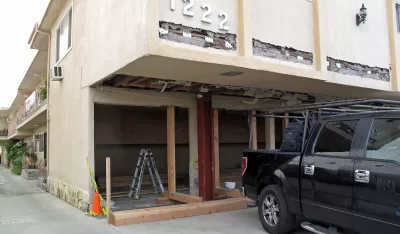
In the wake of the devastating earthquake in Turkey and Syria, the Los Angeles County Board of Supervisors voted to create rules for a mandatory retrofit of county-owned buildings and those located in unincorporated county areas. Rebecca Ellis and Rong-Gong Lin II report on the story for the Los Angeles Times.
The targeted buildings, called ‘non-ductile,’ involve a lack of sufficient steel reinforcement in their concrete frames, which can lead to catastrophic collapse. “That type of construction was deemed so unsafe that it was banned for future construction by the 1980s. But most local governments have done little to order older buildings be evaluated and strengthened if found to be deficient.” Non-ductile buildings have caused significant casualties in earthquakes around the world.
“The supervisors also ordered officials to create an inventory in unincorporated areas of all ‘soft-story’ residential buildings — structures vulnerable to come tumbling down in the next big earthquake,” such as the well-known L.A. ‘dingbats,’ a type of apartment building whose second story rests on thin supports above ground-level carports popular in the mid-20th century. In 2015, the city of Los Angeles took a similar action, going a step further to require seismic retrofits on thousands of non-ductile and soft-story buildings (not all of which have complied with the ordinance). Other California cities have implemented similar ordinances for non-ductile, soft-story, or both types of buildings.
Read the full story: L.A. County moves to require quake retrofits as Turkey-Syria death toll exceeds 50,000

Los Angeles opens public housing waitlist for first time in over two years
The 16 properties with newly available waitlist spots accept families and senior residents.
LA County's 'Beach Bus' offers $6 round-trip rides from inland LA to the beach
The annual summer service shuttles residents from eastside communities to Santa Monica.
LA Proposal Would Forcibly Remove Unhoused People Near Olympic Venues
Los Angeles County sent city officials a report outlining strategies for clearing homeless encampments, but advocates point out that the report itself notes there are not enough shelte resources to accommodate all unhoused residents.

Planetizen Federal Action Tracker
A weekly monitor of how Trump’s orders and actions are impacting planners and planning in America.

The state-sanctioned urbicide of Austin
People don’t kill cities. Freeways do.

US to reduce Colorado River water deliveries to Mexico
A new Colorado Treaty amendment reduces Mexico’s Colorado River water allocation by 250,000 acre feet.

Nation's most wind-powered state turns to coal as data centers increase energy demand
For the first time in decades, Iowa has increased its generation of coal power.

NYC cools commuters with city's first rain garden above a bus stop
New York City officials say the plants in the rain garden can absorb 16 gallons of rainwater during heavy storms.

Brightline West’s future may rely on $6 billion federal loan
The company has until Nov. 2 to make a $400 million equity investment into its proposed high-speed rail line.

FREE Course: Walkable City 1: Why Walkability?
After describing his path towards focusing on walkability as the essence of good planning, Jeff Speck marches through his five principal reasons for making more walkable places.
Reinventing Malls: Planning Alchemy—Turning Gray Fields Into Gold
The course focuses on the opportunities and imperatives that shape reinvention of mall sites.


Greater Baltimore Committee
Eagle County Government
Harvard University Graduate School of Design
The Architects Foundation
University of Cincinnati Online
The Pocatello Development Authority
The Urban Renewal Agency of the City of Pocatello
Journal of the American Planning Association