Does the work of Jane Jacobs support restrictive zoning?



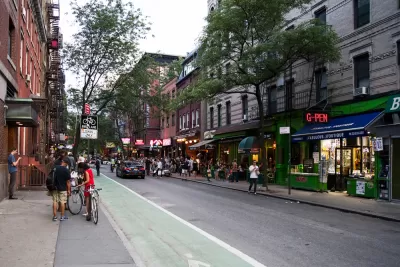
A recent article by law professor Richard Schragger invokes Jane Jacobs’ Death And Life of Great American Cities (“Death and Life”) in defense of zoning. Schragger writes that, according to Jacobs, city neighborhoods flourish because of “the diversity of land uses in space” and that zoning should protect the desirability of such neighborhoods by “zoning for diversity,” which requires “limiting development, controlling density, and preserving historic structures.” If a neighborhood becomes too popular, the ultimate result is the “self-destruction of diversity” or, in Schragger’s words, “when the features of a location that create housing demand are eliminated by fulfilling that demand-as when new high-rise construction replaces smaller, older, mixed-use buildings.”
The pages of Death And Life cited by Schragger (pages 242-52) mostly focused on commerce rather than housing. For example, Jacobs wrote that Eighth Street in Greenwich Village became overly dominated by restaurants and thus monotonous (p. 245). Third Street, by contrast, became too dominated by nightclubs and thus became disorderly (p. 245). Jacobs added that “banks, insurance companies and prestige offices” are especially destructive to diversity (p. 250).
However, Jacobs did have something to say about residential blocks. She wrote that when an area becomes popular, “it becomes profitable to build, in excessive and devastating quantity, for those who can pay the most. These are usually childless people… people who can or will pay the most for the smallest space.” As a result, families and uses less profitable than small apartment units are crowded out, causing the area to become duller.
As a remedy, Jacobs favored “zoning for diversity”—for example, historic preservation laws that ensure that in an area with a mix of low-and high-rise buildings, “the lower buildings remaining could not be further replaced by excessive duplication of the more valuable high buildings” (p. 253). It therefore appears that a Jacobs-inspired zoning code would consistently allow a mix of building heights, rather than zoning some blocks for tall buildings and others for smaller buildings.
However, current zoning does not resemble Jacobs’ ideas at all. Even in urban areas, zoning is designed to create sameness rather than diversity. Most residential land in many cities is zoned for single-family housing and nothing else. Even in New York City, there are many blocks where zoning forces all buildings into the same (usually low-rise) mold. When a building that differs from nearby buildings is proposed, neighborhood activists commonly claim that it is “out of scale” or changes the “neighborhood character.” Thus it seems to me that zoning, as currently configured, reduces rather than increases intra-block diversity.
Zoning in its current form hasn’t succeeded in protecting the kind of diversity that Jacobs wrote about. If any Manhattan neighborhood is frozen in its 1950s form, it is Jacobs’ beloved West Village. Of the 156 West Village apartments currently available for rent, all but 40 are pre-war (that is, built before World War II). If the refusal to accommodate new construction created economic diversity, the West Village would be cheaper and more diverse than newer areas. Instead, the West Village is now one of the city’s most expensive areas; 135 of the apartments (or about 87 percent) rent for $4000 or more, which certainly freezes out economic diversity.
Jacobs suggested that the right kind of zoning would make neighborhoods more family-oriented. Is the West Village more family-friendly than other parts of New York City? According to city-data.com, 16 percent of West Village residents over age 3 are in K-12 schools, about the citywide average.
By contrast, the Upper East Side, another elite part of Manhattan, is newer: only 364 of its 747 for-rent units are pre-war. Has the relative newness of the area driven out diversity? When compared to the West Village, Upper East Side rents are somewhat lower; only about 60 percent (451 out of 747) rent for $4000 or more. And the UES is actually more family-friendly than the West Village; 21 percent of its non-infant residents are in K-12 schools. In the nearby Upper West Side, the percentage is 26 percent.
In sum, Jacobs’s “zoning for diversity” doesn’t resemble zoning as it actually functions today. Thus, it seems unreasonable to invoke her work to support anything resembling the zoning status quo. Moreover, urban zoning as it currently functions doesn’t support Jacobs’ policy goals: affluent neighborhoods that have most successfully excluded new housing aren’t always particularly diverse or family-oriented.


Planetizen Federal Action Tracker
A weekly monitor of how Trump’s orders and actions are impacting planners and planning in America.

Amtrak, CN end decades-long dispute with eight-year agreement
The new operating agreement establishes an updated framework for the companies to work together, including processes to resolve disputes.

Judges permit Denver to divert 77,000 acre feet from the Colorado River for reservoir expansion
Overuse and climate change have caused the Colorado River’s water levels to plummet.

NYC releases high-tech public restrooms — with a 10 minute time limit
The $4 million pilot program aims to make it easier for people to find public restrooms in New York City.

Alabama scores up to $2.5 billion federal loan for largest infrastructure project in state’s history
The Mobile River Bridge and Bayway Project aims to ease congestion at Alabama’s worst bottleneck.

Trump is considering data centers on 6 states' public land — some state officials say they had no idea
If the administration approves the proposed projects, data center and data center-related developments will cover 17,600 acres of public land.

FREE Course: Walkable City 1: Why Walkability?
After describing his path towards focusing on walkability as the essence of good planning, Jeff Speck marches through his five principal reasons for making more walkable places.
Reinventing Malls: Planning Alchemy—Turning Gray Fields Into Gold
The course focuses on the opportunities and imperatives that shape reinvention of mall sites.

KFH Group Inc.
Greater Baltimore Committee
Eagle County Government
The Architects Foundation
University of Cincinnati Online
The Pocatello Development Authority
The Urban Renewal Agency of the City of Pocatello

