Houses of worship in the California city will be allowed to build housing on their properties in an effort to alleviate the city’s housing shortage.


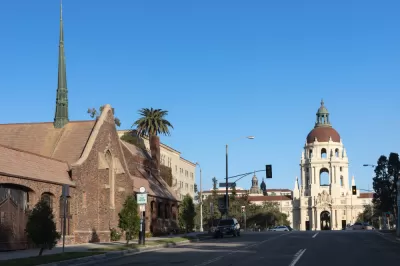
Houses of worship in Pasadena, California will now be able to build up to 75 units of housing on their property, according to an article in The Real Deal. The city council voted to amend the city’s zoning code to allow residential development on land traditionally zoned as commercial.
“Projects would be limited to 36 units an acre, with a maximum of 75 housing units, with a minimum of 80 percent of the housing set aside as affordable.” The rest of the units would also have income requirements, limiting them to households earning up to 150 percent of area median income (AMI).
The amendment excludes areas such as Pasadena’s Central District, “where the commercial ‘character’ of the district is a priority and where high traffic commercial areas ‘detract from housing compatibility.’”
The move is part of the city’s plan to meet its affordable housing needs, particularly the 9,400 new units required by California’s Regional Housing Needs Assessment, which tasks cities with specific goals every eight years. A similar measure, introduced in the state legislature by State Sen. Scott Wiener, would override local zoning codes to allow religious institutions to build affordable housing by-right.
Read the full story: In Pasadena, houses of worship can build affordable housing

Five simple zoning changes that any city can make to increase housing affordability
Zoning for more affordable housing is not rocket science, says Donald Elliot, author of "An Even Better Way to Zone." Here’s his five-step guide to getting started.
St. Pete Allows Housing on Church Land, a Florida First
Religious institutions can now build housing on their properties without rezoning.

Colorado Church Fights for Right to Provide Housing
A church in Castle Rock, Colorado is suing the city, pointing out the lack of shelter options for unhoused residents in the area.

Planetizen Federal Action Tracker
A weekly monitor of how Trump’s orders and actions are impacting planners and planning in America.

The state-sanctioned urbicide of Austin
People don’t kill cities. Freeways do.

Colorado’s Largest Data Center Could Rise Next to Homes — Without a Public Hearing
The proposed campus would consume 11 times the power of Denver International Airport; as it has across the country, opposition mounts.

Nation's most wind-powered state turns to coal as data centers increase energy demand
For the first time in decades, Iowa has increased its generation of coal power.

NYC cools commuters with city's first rain garden above a bus stop
New York City officials say the plants in the rain garden can absorb 16 gallons of rainwater during heavy storms.

Brightline West’s future may rely on $6 billion federal loan
The company has until Nov. 2 to make a $400 million equity investment into its proposed high-speed rail line.

FREE Course: Walkable City 1: Why Walkability?
After describing his path towards focusing on walkability as the essence of good planning, Jeff Speck marches through his five principal reasons for making more walkable places.
Reinventing Malls: Planning Alchemy—Turning Gray Fields Into Gold
The course focuses on the opportunities and imperatives that shape reinvention of mall sites.

Greater Baltimore Committee
Eagle County Government
Harvard University Graduate School of Design
The Architects Foundation
University of Cincinnati Online
The Pocatello Development Authority
The Urban Renewal Agency of the City of Pocatello
Journal of the American Planning Association