In response to a spike in complaints from people living near bars and clubs, Houston has updated its noise ordinance to raise fines and require additional permits for amplified sound.


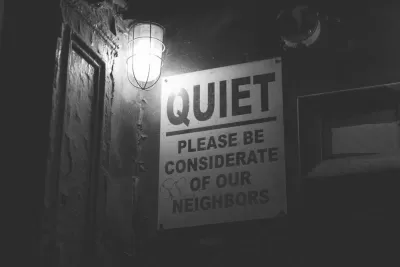
Recent updates to Houston’s noise ordinance seek to curb complaints from neighbors of bars and clubs, which rose sharply this year, up 44 percent between January and March of 2022. As Dylan McGuinness reports in the Houston Chronicle, the updated ordinance doubles the fine for noise violations and adds new permitting rules for amplified sound.
“The rules, passed by City Council in May, marked a compromise city officials said was necessary to balance competing interests: a boisterous nightlife scene and residents fed up with late-night music piping into their nearby homes,” McGuinness writes.
According to the article, “The measurement for those noise volumes would be taken from the property of any resident who calls police, under the ordinance. Officers would have to take a decibel reading with a certified sound meter to cite a business.”
Noise pollution is increasingly being recognized as a significant detriment to public health, and other cities, such as Paris and New York, are experimenting with automated enforcement using cameras and decibel meters to measure noise and identify violators.
FULL STORY: New nighttime noise rules take effect in Houston, doubling fine for rowdy bars


Sound Equity: The Unequal Impacts of Covid’s ‘Great Silence’
During the pandemic, many neighborhoods became quieter than ever—but not everyone experienced the benefits equally.

The Case Against Noise Pollution
A detailed description of how noise impacts health and wellbeing.

Using Tech to Control Noise Pollution
Several cities are piloting programs that use machine learning to identify and understand urban noise patterns and enforce noise ordinances.

Planetizen Federal Action Tracker
A weekly monitor of how Trump’s orders and actions are impacting planners and planning in America.

The state-sanctioned urbicide of Austin
People don’t kill cities. Freeways do.

US to reduce Colorado River water deliveries to Mexico
A new Colorado Treaty amendment reduces Mexico’s Colorado River water allocation by 250,000 acre feet.

5 New England states march closer to 800 megawatt wind energy project
Securing federal approval for the project may be complicated under the Trump administration, which has historically been hostile towards domestic wind power.

Baltimore to break ground on $50 million Transit Priority Project
The project will bring faster bus trips, safer streets and better bike connections to Baltimore.

Airbnb launches $250 million 'last-dollar financing' housing accelerator, makes first investment in Austin
The company will put $6.4 million towards affordable housing development in Texas’ capital.

FREE Course: Walkable City 1: Why Walkability?
After describing his path towards focusing on walkability as the essence of good planning, Jeff Speck marches through his five principal reasons for making more walkable places.
Reinventing Malls: Planning Alchemy—Turning Gray Fields Into Gold
The course focuses on the opportunities and imperatives that shape reinvention of mall sites.

Eagle County Government
Harvard University Graduate School of Design
Nashville Planning Department
The Architects Foundation
University of Cincinnati Online
The Pocatello Development Authority
The Urban Renewal Agency of the City of Pocatello
Journal of the American Planning Association