Terminology referring to people living without permanent housing changes frequently. Today, the term 'unhoused' is gaining ground among advocates. Why, and why does it matter?


This article is based on an interview with Dictionary.com Senior Director of Editorial John Kelly and Dictionary.com lexicographer Heather Bonikowski.
Throughout history, language has been ever-changing and fluid. Vocabulary comes and goes, evolving with cultural, social, and political shifts. In the last half century, we have seen a whole host of words morph from legal terms to euphemisms to, sometimes, downright slurs. As a word ages, it gains layers of meaning, both explicit and implicit, transforming it over time. According to Dictionary.com lexicographer Heather Bonikowski, this is a linguistic concept called the “euphemism treadmill,” in which a term originally meant to be the less offensive word gains negative baggage that creates a negative image around the term.
As such, society frequently updates language to eliminate insulting terminology, words that come with heavy connotational baggage, and exclusive language that ignores the experiences of minority or marginalized groups. We have seen this evolution unfold with language that relates to race, gender, sexual identity, disability, religion, addiction, mental health, and other topics that can marginalize and exclude certain groups. Dictionary.com Senior Director of Editorial John Kelly believes this points to a broader cultural mood shift. “It signals progress,” Kelly says, and a willingness to expand our circle of empathy to more groups that may not quite fit into mainstream American identity.
Recently, advocates and researchers have begun to question the usage of the term “homeless,” particularly when used as a collective noun (“the homeless”). While the term is still widely used—and in some cases, preferred—by community members and the media, some argue that the term dehumanizes the people experiencing homelessness and flattens their identity into one stigmatized characteristic.
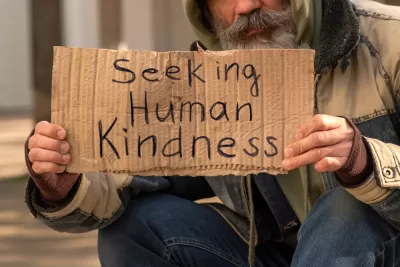
In light of this discussion, Dictionary.com recently added ‘unhoused’ to their database as a unique term suitable for replacing ‘homeless.’ According to Kelly, acknowledging more inclusive terms like ‘unhoused’ and ‘unsheltered’ “can attend to an increasingly diverse set of experiences” and elevate the humanity of people experiencing homelessness rather than defining a large swath of the population by one temporary trait. Some advocates also prefer “people without homes” and ‘houseless’ as appropriate substitutes.
Furthermore, some unsheltered people resent the implication that they have no “home.” In some cases, people view a city or community as their home—whether or not they have a roof over their heads, rent housing, or own property there. The condition of being unsheltered denotes the lack of physical shelter, while ‘homeless’ may also imply the lack of permanent housing experienced by people living in cars, temporary shelters, or with friends.
In many cases, the use of the term ‘homeless’ carries baggage that brings with it connotations of personal failings, drug use, and other stigmatizing assumptions. When people reference “the homeless,” they often minimize the effect of social status, disability, and access to resources as crucial factors in how and why people become unhoused. According to Bonikowski, in media coverage and literature, words like ‘unhoused’ and ‘unsheltered’ are often used with more positive connotations than ‘homeless,’ such as referring to “unhoused neighbors.” Referring to people “experiencing homelessness” or being unhoused or unsheltered can imply a worldview that sees homelessness as a structural and societal failing, not a personal problem. In a search of the California Digital Newspaper Collection, ‘homeless’ made an appearance more than 95,000 times. Meanwhile, ‘unhoused’ and ‘unsheltered’ were used a total of roughly 1,500 times. New terms like these often come from specialized fields—in this case housing advocacy—and make their way into the mainstream. Changing the language can help shed longstanding stigmas and encourage people to view marginalized groups with more empathy. As Bonikowski puts it, there are three people in every conversation: the speaker, the person being spoken about, and the person being spoken to. Too often in conversations about homelessness, the person being spoken about is absent from the room.
Today, the issue of homelessness has been thrust into the public eye more than ever as more and more people experience housing insecurity. In a way, says Kelly, social forces have made the issue more visible and more relatable as more Americans see their own financial situation become more precarious. Today, more people than ever fear falling into homelessness themselves, or have friends or family who are unhoused. In August 2021, almost half of adult renters surveyed by the Census Bureau said they were “very likely” or “somewhat likely” to be evicted in the next two months. In the same survey, 14 percent of renters were behind on rent payments. According to the Department of Housing and Urban Development, “The number of sheltered individuals with chronic patterns of homelessness increased by 20 percent between 2020 and 2021.”
Thanks in part to these unfortunate trends, many Americans now have a different level of empathy for people in dire economic conditions, and changes in language can serve as a barometer for social concerns. Kelly acknowledges that “these debates are hard, confusing, and weaponized.” But they are also “an indication that, in our language, we’re attending to a broader array of people who have been historically marginalized.”
[Updated July 6, 2022 to correct John Kelly's title. He is Senior Director of Editorial at Dictionary.com.]

U.S. Supreme Court Upholds Camping Bans, but Challenges of Addressing Homelessness Remain
In Grants Pass v. Johnson, the Supreme Court upheld an Oregon city’s ban on camping in public places, paving the way for similar bans in cities across the country but doing nothing to solve the cause of homelessness.
Los Angeles Tightens Restrictions on Encampments
During a city council meeting that had to pause while police cleared the room of activists opposing the measure, the council voted to ban public sleeping within 500 feet of schools, making one-fifth of city sidewalks off-limits to unhoused people.

LA has no plan — or funding — to help unhoused people displaced by Olympics security efforts
City and county officials say they don't have the funds to offer housing to the up to 1,600 people that will be displaced by perimeters around event venues.

Planetizen Federal Action Tracker
A weekly monitor of how Trump’s orders and actions are impacting planners and planning in America.

‘Going backwards:’ Baltimore mayor, students rally against state's transit funding plan
Maryland's proposed six-year plan provides no funding for Baltimore’s BMORE bus program and reduces its road maintenance funding.

Detroit to transform waterfront with $2.2 billion investment
Developers will convert about 18 acres of unused parking lot space into civic spaces.

Less housing, wasted money: study reveals impact of city parking mandates
The study found that 71% of carless households in the United States pay for a parking space they don’t use.

Minnesota seeks to replace fraud-ridden Housing Stabilization Services with new program
Federal prosecutors have charged over a dozen people in fraud cases involving at least $26 million.

A multi-billion dollar problem is brewing under Oakland’s streets
Oakland’s stormwater drainage systems are in desperate need of upgrades and repairs. The El Niño will only further strain the city’s infrastructure.

FREE Course: Walkable City 1: Why Walkability?
After describing his path towards focusing on walkability as the essence of good planning, Jeff Speck marches through his five principal reasons for making more walkable places.
Reinventing Malls: Planning Alchemy—Turning Gray Fields Into Gold
The course focuses on the opportunities and imperatives that shape reinvention of mall sites.

One Hundred Miles
County of Mendocino
planning NEXT
The Architects Foundation
University of Cincinnati Online
Montrose County
Northern Illinois Transit Authority (NITA)
The Pocatello Development Authority

