A tour de force of reporting documents the efforts of suburban Maryland residents to oppose new developments in their neighborhoods.


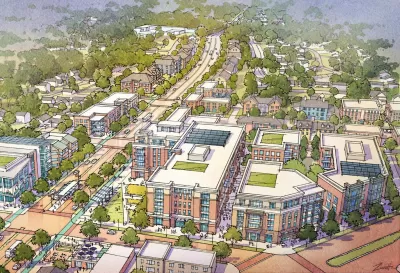
An article written by Ally Schweitzer and published by DCist earlier this week has produced a detailed, feature-length documentation of the current state of planning in the state of Maryland. It's a story about local veto power holding proposals for new residential density at bay using a variety of legal and political tools that will be familiar to planners in many expensive, growing metropolitan areas around the country.
The story starts in 2011 at a hearing of the Montgomery County Planning Board in Silver Spring, Maryland, when residents of the Seven Oaks Evanswood Citizens Association gathered to oppose a proposed development of 76 townhomes on the former location of a private school.
“We invested in a single-family home neighborhood,” testified a homeowner. “If we wanted townhouses to be a part of that equation, we would have purchased elsewhere.”
Schweitzer sums up the conflict to tie the example to the ongoing push and pull of planning politics around the region and the country.
"Fights like this play out every day in cities and suburbs across the country. But in the D.C. region, where local governments are struggling to address a severe housing shortage that is driving up prices, elected officials are under growing pressure to push back against civically engaged homeowners who mobilize against new housing construction," writes Schweitzer.
Planetizen's archive supports that narrative: where planners and some politicians have gained major traction in recent years, implementing zoning reforms that would have been unthinkable in earlier decades. At the same time, local groups, some that can be rightly described as NIMBYs, are finding new ways to wield political power in preventing the trend toward new density.
The political conflict surrounding new density is especially salient in 2022 as the county considers approval of the Thrive Montgomery 2050 plan, a long-range general plan in the works since 2020. "Resistance to the plan, called Thrive Montgomery 2050, is loud and persistent. County council members — most of whom are either up for re-election or running for other elected offices this year — have responded by holding additional hearings and delaying a vote on the plan by several months," writes Schweitzer.
Schweitzer's deep coverage of the issue cites numerous experts, data, and analysis of the motivations of the "neighborhood defenders" who have wielded their local veto so effectively over the years. The article promises to stand next to Kim-Mai Cutler's seminal documentation of similar political power in the San Francisco Bay Area, published by TechCrunch almost exactly eight years ago. The challenges described by Cutler and Schweitzer have only deepened in San Francisco and D.C and spread to new corners of the country. Look for more definitive works like these soon.
FULL STORY: In Montgomery County, ‘Neighborhood Defenders’ Fight To Maintain The Suburban Status Quo


Austin’s ‘Affordability Unlocked’ Initiative Faces Lawsuit
A group of 18 plaintiffs is suing to overturn the city of Austin’s “Affordability Unlocked” planning initiative.
Density Skepticism and Neighborhood Protection
Resistance mounts to the zoning reforms gaining traction in the United States.

Lack of Multi-Family Zones Contributes to Nashville’s High Housing Costs, Study Says
Nashville and surrounding communities allow for a relatively small amount of multi-family housing, according to a new zoning atlas of Middle Tennessee. A regionally focused nonprofit is using the atlas to push for zoning reforms.

Planetizen Federal Action Tracker
A weekly monitor of how Trump’s orders and actions are impacting planners and planning in America.

The state-sanctioned urbicide of Austin
People don’t kill cities. Freeways do.

US to reduce Colorado River water deliveries to Mexico
A new Colorado Treaty amendment reduces Mexico’s Colorado River water allocation by 250,000 acre feet.

Mamdani overhauls NYC's Vision Zero plan with 100 new policy goals
The overhaul aims to reduce traffic deaths and make streets safer for pedestrians, cyclists and drivers through lower speed limits, new safety infrastructure and more.

Amtrak not solely to blame for New Jersey commuter rail's unreliability, report finds
A new study from the Garden State Initiative found that NJ Transit’s budget grew 20% across a 4 year period, but reliability declined significantly over the same period.

EPA erases limits on planet-warming pollution from power plants
Under Monday’s plan, power plants would still have some limits on how much mercury, arsenic and other contaminants they can emit.

FREE Course: Walkable City 1: Why Walkability?
After describing his path towards focusing on walkability as the essence of good planning, Jeff Speck marches through his five principal reasons for making more walkable places.
Reinventing Malls: Planning Alchemy—Turning Gray Fields Into Gold
The course focuses on the opportunities and imperatives that shape reinvention of mall sites.

Eagle County Government
Harvard University Graduate School of Design
Nashville Planning Department
The Architects Foundation
University of Cincinnati Online
The Pocatello Development Authority
The Urban Renewal Agency of the City of Pocatello
Journal of the American Planning Association