The program, which gives tax credits to investors, has resulted in added jobs, increased incomes, and low rates of displacement.


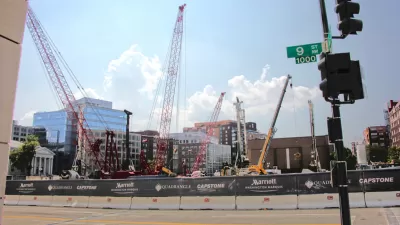
Oscar Perry Abello reports on new research from the Urban Institute that analyzes the effects of the federal New Markets Tax Credit (NMTC), a program established in 2000 that "provides an incentive for investment in low-income communities." According to the Tax Policy Center, "NMTC investors provide capital to community development entities (CDEs), and in exchange are awarded credits against their federal tax obligations." The study, which looked at 5,746 investments in the program's first round, "finds the New Markets Tax Credit program does what it promises, most of the time, and doesn’t seem to cause displacement in the way that many fear the newer Opportunity Zones tax incentives may."
Between 2001 and 2017, investors—mainly large banks—received $12.2 billion in tax credits, which translated into $107 billion in total investment. In terms of uses, retail projects proved most popular with 17% of projects. "Manufacturing and food processing projects came in next, at 828 investments, followed by 719 office or professional service projects, 619 health care facilities projects, and 600 school and child care projects. The rarest were investments into financial intermediaries that serve low-to-moderate income communities, like Hope Credit Union."
The type of project can dictate the number and quality of jobs created, as well as the project's impact on the broader community. "Hope Credit Union used New Markets Tax Credits to grow during the Great Recession, going from less than ten branches to nearly 30 across the Deep South — creating or preserving a good number of jobs internally, but also having an even larger indirect impact by preserving access to credit in many communities that lost all other banking providers." The study also found an average of "17.7 new firms and 100 new jobs" in census tracts with NMTC projects and "a $562 increase in median incomes for some census tracts." The research showed little displacement in NMTC neighborhoods, with "only a modest increase in the turnover rate."
To implement similarly successful programs, the researchers recommend a "rigorous process to certify eligible projects" and "sizing incentives based on potential impact, as opposed to tying incentives to potential rise in property values–as is the case with Opportunity Zones."
Read the full story: Who Benefits From the New Markets Tax Credit? New Research Dives Into 5,000 Projects to Find Out

Debating Public Incentives for Private Developments
A debate common in growing cities around the country is taking place in Atlanta in answer to the question of how much support private developers need from the public.
Philadelphia Project Seeks Diverse Array of Investors
A development project in Philadelphia is raising funds through a combination of Opportunity Zones benefits, federal tax credits, and crowdfunding.
The nation's 10 'stickiest' downtowns
How often do residents visit your downtown?

Planetizen Federal Action Tracker
A weekly monitor of how Trump’s orders and actions are impacting planners and planning in America.

Colorado’s Largest Data Center Could Rise Next to Homes — Without a Public Hearing
The proposed campus would consume 11 times the power of Denver International Airport; as it has across the country, opposition mounts.

US to reduce Colorado River water deliveries to Mexico
A new Colorado Treaty amendment reduces Mexico’s Colorado River water allocation by 250,000 acre feet.

'This is going to be painful:’ Virginia stares down $1.7 billion funding gap for highway maintenance
The state may address the deficit by shifting $290 million from its construction budget to maintenance projects.

Judges permit Denver to divert 77,000 acre feet from the Colorado River for reservoir expansion
Overuse and climate change have caused the Colorado River’s water levels to plummet.

Amtrak, CN end decades-long dispute with eight-year agreement
The new operating agreement establishes an updated framework for the companies to work together, including processes to resolve disputes.

FREE Course: Walkable City 1: Why Walkability?
After describing his path towards focusing on walkability as the essence of good planning, Jeff Speck marches through his five principal reasons for making more walkable places.
Reinventing Malls: Planning Alchemy—Turning Gray Fields Into Gold
The course focuses on the opportunities and imperatives that shape reinvention of mall sites.

KFH Group Inc.
Greater Baltimore Committee
Eagle County Government
The Architects Foundation
University of Cincinnati Online
The Pocatello Development Authority
The Urban Renewal Agency of the City of Pocatello