A federal judge has ruled that the city and county of Los Angeles, home to the nation's largest population of people experiencing homelessness, must overcome the development delays that have prevented the creation of new supportive housing.



"A federal judge overseeing a sprawling lawsuit about homelessness in Los Angeles ordered the city and county Tuesday to offer some form of shelter or housing to the entire homeless population of skid row by October," report Benjamin Oreskes, Emily Alpert Reyes, and Doug Smith.
"The ruling argues that L.A. city and county wrongly focused on permanent housing at the expense of more temporary shelter, 'knowing that massive development delays were likely while people died in the streets.'"
According to the article, 1,300 people experiencing homelessness died in the past year. And, "In the last homeless count in January 2020, more than 4,600 unhoused people were found to be living on skid row — about 2,500 in large shelters and 2,093 on the streets." Those numbers account for about 10 percent of the total population of people experiencing homelessness in the city.
The article also adds that it's unclear what the judge's order means for people experiencing homelessness living in other parts of the city.
Read the full story: Judge orders L.A. city and county to offer shelter to everyone on skid row by fall

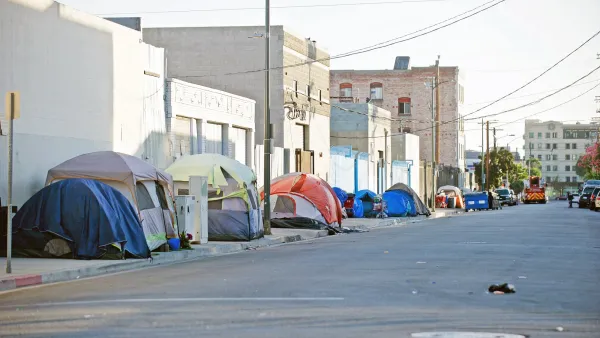
Judge Presses Pause on Controversial Skid Row Housing Order
A 60-day grace period and some additional contingencies have been added to a court order for the city and county of Los Angeles to provide shelter or housing to the thousands of people experiencing homelessness on Skid Row in Downtown Los Angeles.
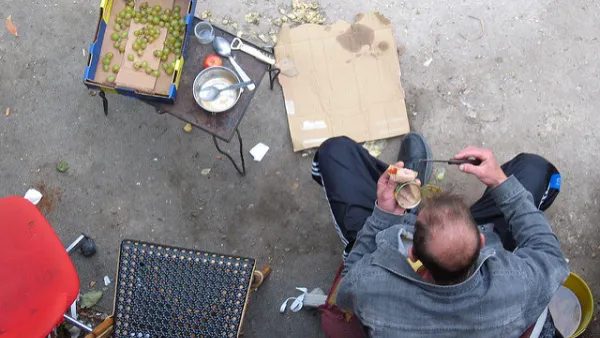
Will Appeal of Landmark Appeals Court Ruling Allow for Clearing of Tent Cities?
If the Supreme Court hears an appeal of a landmark U.S. Ninth Circuit Court case settled in April, the ruling would have widespread implications for dealing with homeless encampments throughout the West, perhaps nowhere more so than Los Angeles.
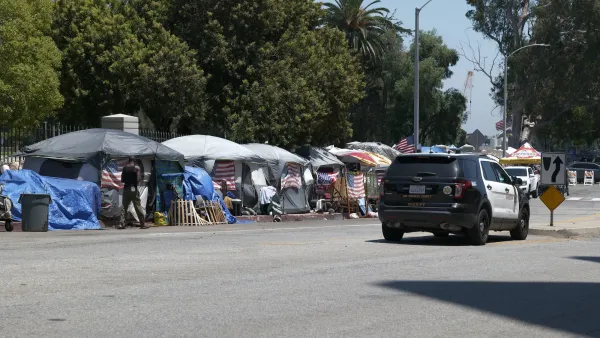
Study: LA’s Homelessness Program Displaced 5 People for Every One it Helped
Researchers say a city program designed to help people access housing and services “does not live up to its name” and has caused more harm than good.

Planetizen Federal Action Tracker
A weekly monitor of how Trump’s orders and actions are impacting planners and planning in America.

The state-sanctioned urbicide of Austin
People don’t kill cities. Freeways do.

US to reduce Colorado River water deliveries to Mexico
A new Colorado Treaty amendment reduces Mexico’s Colorado River water allocation by 250,000 acre feet.

Nation's most wind-powered state turns to coal as data centers increase energy demand
For the first time in decades, Iowa has increased its generation of coal power.

NYC cools commuters with city's first rain garden above a bus stop
New York City officials say the plants in the rain garden can absorb 16 gallons of rainwater during heavy storms.

Brightline West’s future may rely on $6 billion federal loan
The company has until Nov. 2 to make a $400 million equity investment into its proposed high-speed rail line.

FREE Course: Walkable City 1: Why Walkability?
After describing his path towards focusing on walkability as the essence of good planning, Jeff Speck marches through his five principal reasons for making more walkable places.
Reinventing Malls: Planning Alchemy—Turning Gray Fields Into Gold
The course focuses on the opportunities and imperatives that shape reinvention of mall sites.

Eagle County Government
Harvard University Graduate School of Design
Nashville Planning Department
The Architects Foundation
University of Cincinnati Online
The Pocatello Development Authority
The Urban Renewal Agency of the City of Pocatello
Journal of the American Planning Association