Patrick Condon argues that increasing density without affordability inflates urban land values, resulting in nearly all of the value of labor and creative enterprise of entrepreneurs in regional economies being absorbed as land wealth.



Central to arguments in favor of state control over local planning and land use decisions is the claim that increasing housing supply trickles down and increases the affordability of existing units. In his new book, Sick City: Disease, Race, Inequality, and Urban Land, author Patrick Condon, chair of the Urban Design program at the University of British Columbia, harkens back to 19th century political economist Henry George to argue that increasing density without affordability inflates urban land values to the benefit of speculators, resulting in nearly all of the value of individual labor and creative enterprise of entrepreneurs in regional economies being absorbed as land wealth.
Condon offers solutions for disciplining land markets and correcting land value inflation citing Cambridge, Massachusetts' 100% affordable housing overlay and other regulatory mechanisms in Portland and Vienna for ensuring permanently affordable housing supply. TPR shares a presentation by Condon from a recent Livable California town hall providing an overview of his book, a full creative commons copyright version of which can be found online, here.
For the presentation, visit The Planning Report.
FULL STORY: Patrick Condon: Density, Affordability, & The 'Hungry Dogs' of Land Price Speculation


Wellesley sues state over proposed housing on state-owned parking lot
The college town opposes a 180-unit development that it says creates too much density for the area.
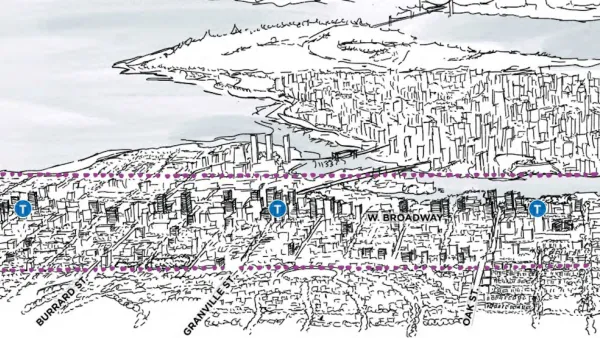
Vancouver’s Controversial Broadway Plan Approved With Amendments
A plan to add new significant amounts of housing, shifting development south into a “second downtown” around the future SkyTrain Millennium Line Broadway Extension, has been approved in Vancouver.

California Cities Could Face a Zoning Reckoning
As the state toughens rules related to its housing allocation process, cities statewide may finally be forced to overhaul their zoning codes to ensure an adequate supply of housing at all affordability levels.

Planetizen Federal Action Tracker
A weekly monitor of how Trump’s orders and actions are impacting planners and planning in America.

The state-sanctioned urbicide of Austin
People don’t kill cities. Freeways do.

US to reduce Colorado River water deliveries to Mexico
A new Colorado Treaty amendment reduces Mexico’s Colorado River water allocation by 250,000 acre feet.

Mamdani overhauls NYC's Vision Zero plan with 100 new policy goals
The overhaul aims to reduce traffic deaths and make streets safer for pedestrians, cyclists and drivers through lower speed limits, new safety infrastructure and more.

Amtrak not solely to blame for New Jersey commuter rail's unreliability, report finds
A new study from the Garden State Initiative found that NJ Transit’s budget grew 20% across a 4 year period, but reliability declined significantly over the same period.

EPA erases limits on planet-warming pollution from power plants
Under Monday’s plan, power plants would still have some limits on how much mercury, arsenic and other contaminants they can emit.

FREE Course: Walkable City 1: Why Walkability?
After describing his path towards focusing on walkability as the essence of good planning, Jeff Speck marches through his five principal reasons for making more walkable places.
Reinventing Malls: Planning Alchemy—Turning Gray Fields Into Gold
The course focuses on the opportunities and imperatives that shape reinvention of mall sites.

Eagle County Government
Harvard University Graduate School of Design
Nashville Planning Department
The Architects Foundation
University of Cincinnati Online
The Pocatello Development Authority
The Urban Renewal Agency of the City of Pocatello
Journal of the American Planning Association