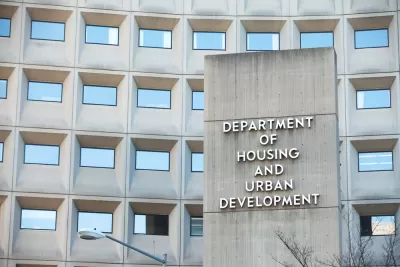
Eviction prevention was an eligible use for CARES Act money...until HUD decided that it's not worth preventing evictions until they are under 14 days away.


Laura Felts, executive director of United Tenants of Albany, in Albany, New York, had never seen the level of need for housing assistance that she has since last March. Calls to her organization’s hotline have tripled. In a typical year UTA gives out about $60,000 in rental assistance funds. In 2020, it awarded that amount just between October and November. There is no end to the need in sight.
And yet Felts says she expects things are going to get much worse, thanks to confusion over whether federal homelessness prevention grants can actually be used to help renters while an eviction moratorium is in place.
In March, as part of the CARES Act, Congress allocated $4 billion for Emergency Services Grants (or ESG) to provide for more shelters and prevent homelessness in the wake of the economic destruction wrought by the COVID-19 pandemic.
In September the Centers for Disease Control issued an eviction moratorium whereby renters could fill out a form demonstrating their financial situation and risk of homelessness, present it to their landlords, and theoretically not be evicted for nonpayment of rent.
But evictions due to lack of payment have persisted across the country, whether because tenants don’t know to sign the declaration, courts aren’t checking for it, or judges are agreeing with landlords that the ban is unconstitutional.
Tracy Pitcher, executive director of St. Paul’s Center, a housing aid organization in Rensselaer, New York, says tenants she works with who report they have lost jobs and are unable to pay are also dealing with landlords who are accusing them of “abusing” this moratorium. “We receive reports that landlords are hostile toward them, are refusing to make needed repairs, are turning off heat, or are locking them out,” she says. “Recently, we have tenants report that their leases are up and their landlords are using that as an opportunity to not renew their leases so they must leave.”
And even if the moratorium were working as intended, the time to help tenants and clear up rent debt would be now, argues Felts, rather than leaving everyone in limbo to hit housing court all at once when the moratorium lifts.
Unfortunately, even though some money at least is there, in the Capital Region of New York, and possibly in other places around in the country, it’s not being used for that purpose.
In November, Felts learned through the local Continuum of Care, the regional group tasked with managing funds to combat homelessness, that HUD was of the opinion that renters facing financial hardship aren’t eligible for the grants until the moratorium expires, because in theory they aren’t in imminent danger of homelessness.
This opinion was relayed to the local CoC and then to Felts piecemeal, through HUD webinars and its AAQ (Ask a Question) help desk, which issues non-legally-binding opinions.
“Due to the CDC Eviction Moratorium, the earliest time that a ‘covered person’ could qualify for Homelessness Prevention under Category 2 of the Homeless Definition due to an eviction action initiated by a landlord or property owner for nonpayment of rent is 14 days prior to [the moratorium’s expiration],” reads part of HUD’s AAQ response.
Asked to clarify whether HUD’s position is that ESG funds can’t be used to pay rent for those who are going to be evicted until the CDC’s moratorium is lifted, HUD’s press office responded: “It is the responsibility of the PHA/Grantee to ensure there is no duplication of benefits. Determining duplication of benefits is case specific, but in general non-PIH [Public and Indian Housing] funds may be allowable to pay arrearages/prevent homelessness.”
We’ve asked for further clarification specifically about the impact of the moratorium but have yet to hear back.
Felts’s CoC heeded HUD’s AAQ position and isn’t making funds available for ESG grants to prevent evictions. On top of that, HUD has indicated through its AAQ responses that groups could be forced to pay back any ESG funds that were used for that purpose while the moratorium was in effect, dating back to last summer. If so, groups like United Tenants of Albany could be financially devastated.
Groups across the country are trying to sort through the confusion and hoping HUD under the Biden administration will ....
FULL STORY: HUD Won’t Help With Back Rent Until Eviction Moratoriums Are Gone


Mapping Eviction Risk
Millions of renters are at risk of eviction as federal support runs out and the economic realities of the pandemic take hold.
The 'Eviction Tsunami' and Other Pandemic Projections
The ups and downs of the pandemic have been extremely hard to predict, so the consequences of the pandemic have been just as unforeseeable—despite the efforts of a nation of armchair prognosticators.
Supreme Court Strikes Down Federal Eviction Moratorium
The majority opinion claims the CDC overstepped its authority and calls for congressional approval of any further eviction moratoriums.

Planetizen Federal Action Tracker
A weekly monitor of how Trump’s orders and actions are impacting planners and planning in America.

The state-sanctioned urbicide of Austin
People don’t kill cities. Freeways do.

US to reduce Colorado River water deliveries to Mexico
A new Colorado Treaty amendment reduces Mexico’s Colorado River water allocation by 250,000 acre feet.

5 New England states march closer to 800 megawatt wind energy project
Securing federal approval for the project may be complicated under the Trump administration, which has historically been hostile towards domestic wind power.

Baltimore to break ground on $50 million Transit Priority Project
The project will bring faster bus trips, safer streets and better bike connections to Baltimore.

Airbnb launches $250 million 'last-dollar financing' housing accelerator, makes first investment in Austin
The company will put $6.4 million towards affordable housing development in Texas’ capital.

FREE Course: Walkable City 1: Why Walkability?
After describing his path towards focusing on walkability as the essence of good planning, Jeff Speck marches through his five principal reasons for making more walkable places.
Reinventing Malls: Planning Alchemy—Turning Gray Fields Into Gold
The course focuses on the opportunities and imperatives that shape reinvention of mall sites.

Eagle County Government
Harvard University Graduate School of Design
Nashville Planning Department
The Architects Foundation
University of Cincinnati Online
The Pocatello Development Authority
The Urban Renewal Agency of the City of Pocatello
Journal of the American Planning Association