It's not only mom and pop shops that suffer from over-reliance on online shopping: streets and the environment also suffer the consequences.


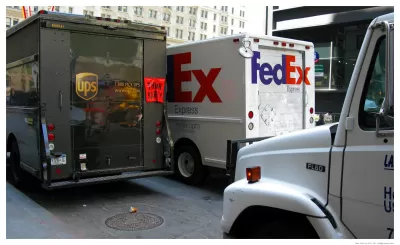
"Almost all the climate and congestion benefits of online shopping are wiped out by rush deliveries, a study finds — which could spell disaster for U.S. roadways this holiday season," reports Kea Wilson.
The study, conducted by researchers from the University of California Davis ITS Institute for Transportation Research, finds that high demand for same-day delivery forces courier companies to send fleets of almost empty trucks to dwellings across the country. These less than ideal conditions lead to congestion and increased carbon emissions
Analysts from the University of California Davis ITS Institute for Transportation Research modeled how the rising popularity of same-day delivery might translate to delivery trucks on our roads and greenhouse gasses in our skies. Unsurprisingly, the faster a company races to deliver a package, the more likely it is to send inefficient, near-empty trucks to far-flung homes.
"The average vehicle miles travelled for a package that was delivered in an hour or less was seven times higher than for a package delivered in as little as 24 hours; per-package nitrogen oxide emissions, meanwhile, were about six times higher for customers who selected the fastest available shipping," Wilson writes.
To remedy the situation, Wilson suggests that done right, a smaller, "slower, more local kind of online retail" could reduce VMT. The more online shopping becomes that status quo, however, the fewer small neighborhood shops an services are lost, argues Wilson.
FULL STORY: How Same-Day Shipping Is Clogging U.S. Roads

Manhattan Traffic Spreading to Other Boroughs
New travel patterns and an increased reliance on delivery services and ride-hailing are creating more congestion in New York's outer boroughs.
Opinion: Los Angeles Must Prioritize Bikes and Buses
L.A. has a plan for improving mobility. Why are city leaders ignoring it?
To Fight Climate Change, Support Public Transit
Electric cars may garner a lot of attention these days, but significantly reducing carbon emissions and urban congestion means investing in high-quality mass transit.

Planetizen Federal Action Tracker
A weekly monitor of how Trump’s orders and actions are impacting planners and planning in America.

The state-sanctioned urbicide of Austin
People don’t kill cities. Freeways do.

US to reduce Colorado River water deliveries to Mexico
A new Colorado Treaty amendment reduces Mexico’s Colorado River water allocation by 250,000 acre feet.

5 New England states march closer to 800 megawatt wind energy project
Securing federal approval for the project may be complicated under the Trump administration, which has historically been hostile towards domestic wind power.

Baltimore to break ground on $50 million Transit Priority Project
The project will bring faster bus trips, safer streets and better bike connections to Baltimore.

Airbnb launches $250 million 'last-dollar financing' housing accelerator, makes first investment in Austin
The company will put $6.4 million towards affordable housing development in Texas’ capital.

FREE Course: Walkable City 1: Why Walkability?
After describing his path towards focusing on walkability as the essence of good planning, Jeff Speck marches through his five principal reasons for making more walkable places.
Reinventing Malls: Planning Alchemy—Turning Gray Fields Into Gold
The course focuses on the opportunities and imperatives that shape reinvention of mall sites.

Eagle County Government
Harvard University Graduate School of Design
Nashville Planning Department
The Architects Foundation
University of Cincinnati Online
The Pocatello Development Authority
The Urban Renewal Agency of the City of Pocatello
Journal of the American Planning Association