Tony Hsieh, who achieved international fame as head both of Zappos and the Downtown Project in Las Vegas, died in November. Several articles made an account of the Downtown Project's track record.


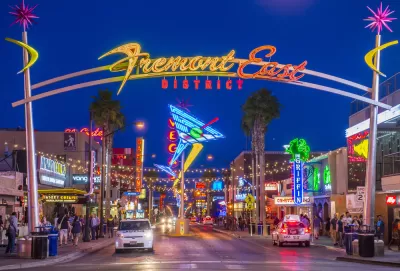
Tony Hsieh died on Friday, November 27 at the age of 46. Hsieh was as famous in planning and development circles for spearheading a singular downtown revitalization movement in Downtown Las Vegas as he was for turning online shoe company Zappos into an internet behemoth.
Writing for the New York Times, Nicholas Bogel-Burroughs and Karen Weise focus on Hsieh's legacy in Las Vegas, where he founded and lead the Downtown Project, which transformed Downtown Las Vegas in one of the most closely watched and analyzed downtown revitalization initiatives in the United States.
One of the central ideas behind the Downtown Project was increasing the number of "collisions" that can happen naturally in a bustling, public-oriented urban environment.
"He tried to increase the number of what he called “collisions” between interesting people in streets and cafes by adding public art and making downtown more walkable. He pitched his friends on moving their start-up ideas to his sandbox, luring hundreds of entrepreneurs," according to Bogel-Burroughs and Weise.
Leah Meisterlin, an assistant professor of urban planning at Columbia University, is quoted in the article describing the Downtown Project as "an early attempt to bring a fast-moving Silicon Valley approach to city planning."
Bailey Schulz and Mike Shoro also focus on the Downtown Project in an article for the Las Vegas Review-Journal, asking if Hsieh's mark on Las Vegas can be considered a success. First, the brass tacks:
According to a 2017 Applied Analysis report, [the Downtown Project] has 407 ongoing or completed construction projects, has brought nearly $210 million in economic output, and helped create more than 1,500 jobs, resulting in roughly $70 million in salaries.
DTP has 61 small business investments within Las Vegas, according to the report, and owns roughly 45 acres of land in and around Fremont East and East Village Districts stretching from Las Vegas Boulevard to 14th Street. Much of that land has yet to be developed.
Critics (mentioned in both articles) of the Downtown Project point to a string of failures among the businesses that located to Las Vegas at Hsieh's beckoning, among other concerns. The article by Schulz an Shoro finds other ways to measure the influence of the Downtown Project, and catches readers up on the status of the Downtown Project since Hsieh left the helm of the initiative around 2014.
Read the full story: No doubt Tony Hsieh impacted Las Vegas. Was his vision a success?
Leadership Change, Layoffs for Las Vegas Downtown Project
The high-profile Downtown Project in Las Vegas, led by Zappos CEO Tony Hsieh, made the wrong kind of news this week.
Questioning the Power Structure of Downtown Las Vegas’ Revitalization
Has the power and influence of Zappos CEO Tony Hsieh spoiled the good intentions of the Downtown Project in Las Vegas?

Five Years Later: Zappos Founder's Downtown Las Vegas Project
Tony Hsieh laid out a grand ambition two create a more dynamic downtown in Las Vegas that would change cities all over the world. Now, after a series of setbacks and with dwindling funds, that vision seems unlikely to be realized.

Planetizen Federal Action Tracker
A weekly monitor of how Trump’s orders and actions are impacting planners and planning in America.

California plans to bury El Niño’s downpour
If the state plays its cards right, it may be able to store a billion acre-feet of El Niño’s water in aquifers.

Desperate measures: Advocates weigh draining Lake Powell to fill Colorado River
Draining the reservoir could reduce evaporation losses by a couple hundred thousand acre-feet.

Chicago voters approve permanent festival grounds, penalty for vacant property owners
Currently, major summer and fall festivals take over public parks for weeks at a time, drawing criticism from nearby residents

NYC votes to cut outdoor dining red tape, speed up permitting
New York City also voted to allow the Department of Transportation to begin work on urgent projects before notifying elected officials.

California appears to reject Prop. 45
The proposition would have expanded the projects that qualify for a streamlined environmental review, effectively paring down the California Environmental Quality Act.

FREE Course: Walkable City 1: Why Walkability?
After describing his path towards focusing on walkability as the essence of good planning, Jeff Speck marches through his five principal reasons for making more walkable places.
Reinventing Malls: Planning Alchemy—Turning Gray Fields Into Gold
The course focuses on the opportunities and imperatives that shape reinvention of mall sites.

City of Rosemead
Rutgers University, Edward J. Bloustein School of Planning and Public Policy
One Hundred Miles
Hunter College, City University of New York (CUNY)
The Architects Foundation
University of Cincinnati Online
City of Cambridge
Montrose County
The Pocatello Development Authority