An innovative tunneling technique, commonly used in Europe, is catching on here in the United States.


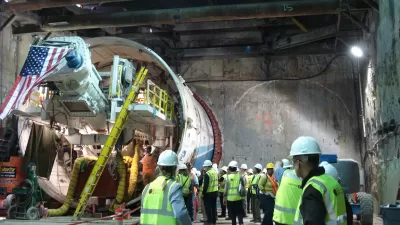
The Brightline high-speed rail extension from West Palm Beach, Florida, to Orlando International Airport (OIA) will use an innovative box-jack system to accelerate the construction timeline of a tunnel from one year to two weeks.
"This is the first time the box-jack system will be used for a train project outside of the Northeast United States," reports Kim Slowey. The construction technique has been implemented once before in the United States, earlier this year on on Long Island Railroad expansion project in New York City.
Here's how Slowey describes the process:
The developer of the box-jacking system, Italian company Petrucco, is using special hydraulic jacks to push two precast concrete boxes — one 146 feet long and the other 126 feet long and both with 42-foot-long sidewalls — under a roadway east of the airport while an excavator digs out a path from inside the box and from the opposite side. Each box weighs more than 3,000 tons, and the installation will take a 40-person crew working 12-hour shifts around the clock.
Granite Construction, the general contractor for a 37-mile stretch of the Brightline extension, says it will consider using the technique for future projects as well.
Read the full story: Brightline shaves almost a year from Florida rail project using precast tunnel system

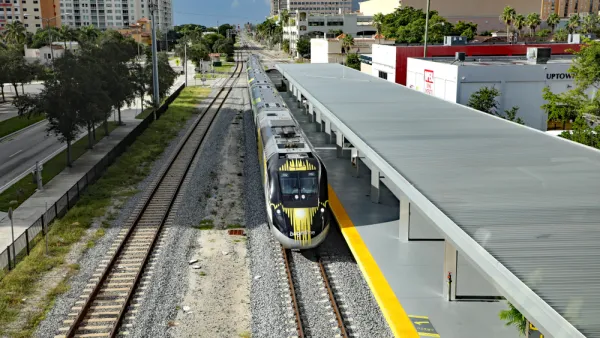
Brightline Opening to Central Florida Delayed
The high-speed rail connection between West Palm Beach and Orlando will not open on time for the holiday weekend as originally planned.
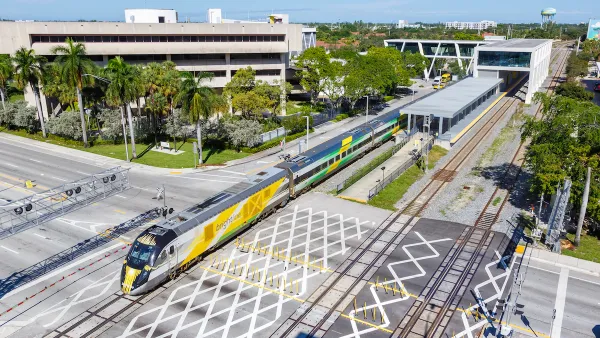
Brightline Completes Higher-Speed Rail Construction in Florida
Florida will soon be home to 170 miles of higher-speed, intercity rail service.
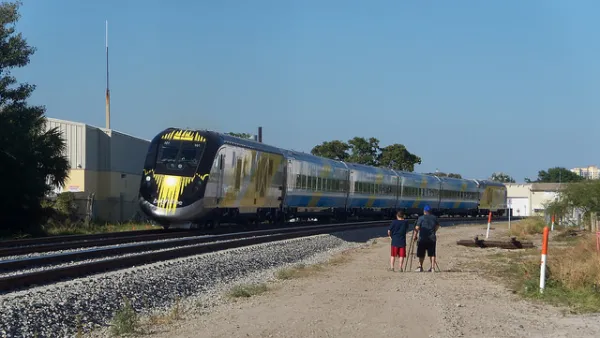
Brightline Unveils New Orlando Train Station; Service Coming in May
Intercity rail service will soon be available between Miami and Orlando.

Planetizen Federal Action Tracker
A weekly monitor of how Trump’s orders and actions are impacting planners and planning in America.

The state-sanctioned urbicide of Austin
People don’t kill cities. Freeways do.

Colorado’s Largest Data Center Could Rise Next to Homes — Without a Public Hearing
The proposed campus would consume 11 times the power of Denver International Airport; as it has across the country, opposition mounts.

Nation's most wind-powered state turns to coal as data centers increase energy demand
For the first time in decades, Iowa has increased its generation of coal power.

NYC cools commuters with city's first rain garden above a bus stop
New York City officials say the plants in the rain garden can absorb 16 gallons of rainwater during heavy storms.

Brightline West’s future may rely on $6 billion federal loan
The company has until Nov. 2 to make a $400 million equity investment into its proposed high-speed rail line.

FREE Course: Walkable City 1: Why Walkability?
After describing his path towards focusing on walkability as the essence of good planning, Jeff Speck marches through his five principal reasons for making more walkable places.
Reinventing Malls: Planning Alchemy—Turning Gray Fields Into Gold
The course focuses on the opportunities and imperatives that shape reinvention of mall sites.

Greater Baltimore Committee
Eagle County Government
Harvard University Graduate School of Design
The Architects Foundation
University of Cincinnati Online
The Pocatello Development Authority
The Urban Renewal Agency of the City of Pocatello
Journal of the American Planning Association