Along with standing up against police violence and systemic racism, we must also fight to end housing systems that devalue Black people.


All I could think of as I scanned a crowd of 4,000 mostly young, white, earnest faces on the Winnetka Village Green was that to end the shame of systemic racism on Chicago’s North Shore, their next step should be to advocate that their suburbs permit affordable housing. Together, those young people can shape a local ethos of welcoming Black neighbors of all incomes and stop the nonsense of treating anyone who is not white or rich as “other.”
That June 6 solidarity rally was nearly 55 years to the day since another generation of north suburban Chicago residents, organized as the North Shore Summer Project and riding the crest of the mass movement for equal rights for Black Americans, held a demonstration of 10,000 people on that very spot. There, Dr. Martin Luther King Jr. famously exhorted, “We must learn to live together as brothers or we will perish together as fools.”
Open housing was indeed the focus of the civil rights movement in the North the way voting rights was in the South. If you wanted to put your finger on the most egregious manifestation of institutionalized racism, it was the unapologetic public and private real estate policies of steering Blacks to substandard housing in isolated Chicago neighborhoods and whites to job-rich and tree-lined neighborhoods and suburbs.
Choosing open housing as the organizing goal was clear. James Bevel, a key strategist of King’s Chicago campaign, said, “Coming up here in 1965, when they were telling me you can’t live here, there, I would not stand for that. That is more of an affront to me, and a violation of me, than not eating at a lunch counter, not going to the theater, or having to go to the back of the bus, and can’t vote. You just can’t tell a man he can’t live somewhere.”
Although President Lyndon Johnson signed the Fair Housing Act into law days after King’s assassination in 1968, real estate professionals, lenders, and indeed local governments have continued to discriminate against Blacks. Blacks are still shown fewer homes than whites and many municipalities and developers alike still use white-only models in promotional ads, perpetuating the perception that African Americans are not welcome. This is why affirmative marketing—taking steps to not merely post “equal opportunity” for all but to invite Black people and other underrepresented legally protected populations to move in—is essential.
Our whitest suburbs are also...
Read the full story: Systemic Racism Starts and Ends with Housing

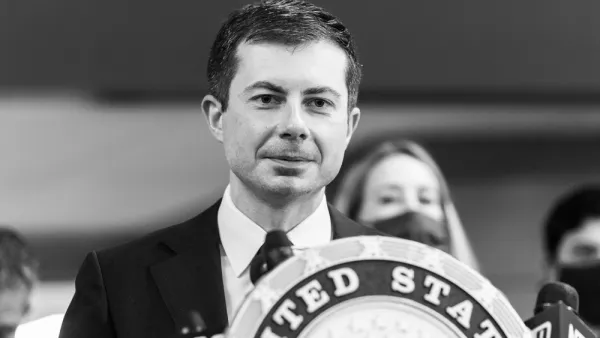
Robert Moses, Robert Caro Back in the News, Along With a Debate About Systemic Racism
Transportation Secretary Pete Buttigieg set off a social media frenzy by referencing an anecdote from "The Power Broker." While some didn't understand the reference, others repeated long-standing questions about the source.
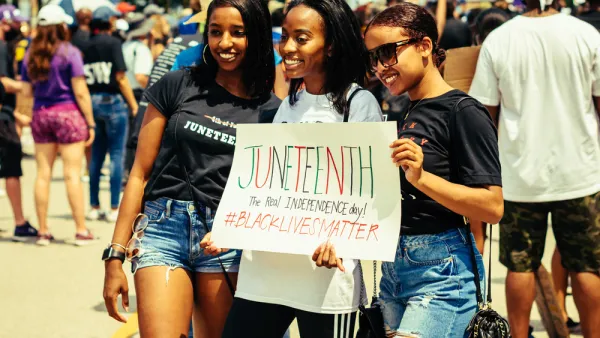
White House Marks Juneteenth by Pushing for Zoning Reforms
On a holiday that commemorates the end of slavery in the United States, the White House marked the occasion by discussion exclusionary zoning.

How to Adopt Long-Term Anti-Racism Solutions as an Urbanist
Nic Esposito calls for an "anti-racist reframe" of urbanism to address the attitudes and policies that have perpetuated racist systems and upheld capitalism at all costs.

Planetizen Federal Action Tracker
A weekly monitor of how Trump’s orders and actions are impacting planners and planning in America.

The state-sanctioned urbicide of Austin
People don’t kill cities. Freeways do.

US to reduce Colorado River water deliveries to Mexico
A new Colorado Treaty amendment reduces Mexico’s Colorado River water allocation by 250,000 acre feet.

Brightline West’s future may rely on $6 billion federal loan
The company has until Nov. 2 to make a $400 million equity investment into its proposed high-speed rail line.

LA Metro’s ultimatum: no extra buses for LA28 if federal funding isn’t imminently secured
If Metro does not provide additional buses, LA28 organizers will have to find a new way to manage Olympic traffic. LA28’s budget does not include a line item for transit.

Colorado’s Largest Data Center Could Rise Next to Homes — Without a Public Hearing
The proposed campus would consume 11 times the power of Denver International Airport; as it has across the country, opposition mounts.

FREE Course: Walkable City 1: Why Walkability?
After describing his path towards focusing on walkability as the essence of good planning, Jeff Speck marches through his five principal reasons for making more walkable places.
Reinventing Malls: Planning Alchemy—Turning Gray Fields Into Gold
The course focuses on the opportunities and imperatives that shape reinvention of mall sites.

Eagle County Government
Harvard University Graduate School of Design
Nashville Planning Department
The Architects Foundation
University of Cincinnati Online
The Pocatello Development Authority
The Urban Renewal Agency of the City of Pocatello
Journal of the American Planning Association