The planner who wrote the book on the emerging practice of scenario planning offers advice on how the tool can be helpful in planning for the pandemic.


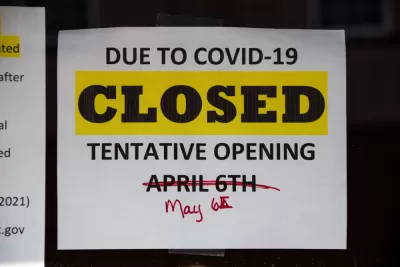
With the Covid-19 pandemic introducing countless uncertainties into the world, organizations ranging from hospitals to school districts to transit agencies are using scenario planning to plan for the future, according to an article and interview published by the Lincoln Institute of Land Policy.
The interview features Robert Goodspeed, an assistant professor of urban and regional planning at the University of Michigan, a board member of the Lincoln Institute's Consortium for Scenario Planning, and author of Scenario Planning for Cities and Regions: Managing and Envisioning Uncertainties (Lincoln Institute of Land Policy, April 2020). The interview touches on the kinds of organizations that could benefit most from scenario planning during and after the pandemic, recommendations for getting started with scenario planning, and examples of pandemic responses already generated by scenario planning.
Goodspeed will also participate in a webinar hosted by the Michigan chapter of the American Planning Association today, May 14, available for AICP CM credit.
Read the full story: How Scenario Planning Can Shape Our Recovery Efforts

More Need Than Ever for Drought Resilience on the Colorado River
The effects of climate change are already cutting deeply into the lifeblood of the U.S. West—the Colorado River.

A New Tool for More Flexible and Resilient Water Policies
A new book created by the Sonoran Institute explains how exploratory scenario planning can be useful to prepare for the uncertainty of water in the near- and long-term future.
Parametric Modeling for Planning in Uncertain Times
A new technology- and data-drive approach to planning could provide direction as society faces challenges of unprecedented scale.

Planetizen Federal Action Tracker
A weekly monitor of how Trump’s orders and actions are impacting planners and planning in America.

California plans to bury El Niño’s downpour
If the state plays its cards right, it may be able to store a billion acre-feet of El Niño’s water in aquifers.

Desperate measures: Advocates weigh draining Lake Powell to fill Colorado River
Draining the reservoir could reduce evaporation losses by a couple hundred thousand acre-feet.

Housing is the top priority of Seattle’s sole new councilmember
Jenks campaigned on building 1,000 new units of affordable housing.

New tax cuts may slash $1.5 billion in funding for Miami transit, public parks
Amendment 3 will save Miami-Dade homeowners $2,700 in 2028.

Arizona, Wisconsin, Pennsylvania hope to finally advance climate goals post-midterms
The three states have spent years under Republican or divided control.

FREE Course: Walkable City 1: Why Walkability?
After describing his path towards focusing on walkability as the essence of good planning, Jeff Speck marches through his five principal reasons for making more walkable places.
Reinventing Malls: Planning Alchemy—Turning Gray Fields Into Gold
The course focuses on the opportunities and imperatives that shape reinvention of mall sites.

City of Rosemead
Rutgers University, Edward J. Bloustein School of Planning and Public Policy
One Hundred Miles
University of Michigan School for Environment and Sustainability (SEAS)
Hunter College, City University of New York (CUNY)
The Architects Foundation
City of Cambridge
Montrose County
The Pocatello Development Authority