The Association of Collegiate Schools of Planning (ACSP) and the Lincoln Institute of Land Policy recently recognized ten land use case studies for addressing some of the biggest challenges facing the world.



The ACSP and the Lincoln Institute of Land Policy have announced the winners of the 2020 Case Study Awards.
The Case Study Awards are designed to “address the rising social, economic, and environmental challenges facing cities across the globe, planners need foundational knowledge and skills as well as opportunities to apply them in real world situations,” according to the request for nominees announced by the organizations earlier this year.
The awards recognized case studies addressing six potential themes:
-
Low-carbon, Climate-Resilient Communities and Regions
-
Efficient and Equitable Tax Systems
-
Fiscally Healthy Communities and Regions
-
Functional Land Markets and Reduced Informality
-
Reduced Poverty and Spatial Inequality
-
Sustainable Land and Water Management
The ten winners, each awarded $2,000 each, are as follows:
-
Colleen Butcher-Gollach: University of Melbourne, Australia; Idyllic possible: planning for affordable and resilient settlements in the pacific island countries
-
Besmira Dyca and Kevin Muldoon-Smith: Northumbria University, UK; Progressive property tax on vacant land - dealing with land speculation in Sao Paulo
-
Minjee Kim: Florida State University; Opportunity for land value capture: land use impacts of the suncoast parkway extension project in citrus county, FL
-
Annette Kim and Andrew Eisenlohr: University of Southern California; The viability of community land trusts in high-priced urban land markets: the case of rolland curtis gardens in Los Angeles
-
Melina Matos, Sierra Woodruff, Malini Roy: Texas A&M University and Philip Gilberson, and Sara Merrow: Arizona State University; Comparing hazard mitigation and climate adaptation plans to understand in practice instruments that foster the creation of climate resilient community
-
Manuel Santana Palacios: University of California, Berkeley; Examining the Linkages Between Investing in Aerial Cable-Cars and the Evolution Informal Transport and Land Development: A Case Study of Ciudad Bolivar, Bogota
-
Emanuel Preciado: University of California, Irvine; Seeds of Resistance: Combating Spatial Inequality with Community Urban Gardens
-
Ross Rubenstein: Georgia State University; Should the Rochester Fast Ferry Sink or Swim?
-
Amruta Sakalker and Adrian Parr: University of Texas at Arlington; Trinity River Park Projects: Which project will be the long-desired bridge that connects the city of Dallas and the Trinity River
-
Henry Webber, Brian Phillips and Jodie Lloyd: Washington University in St. Louis; Forest Park Southeast: One neighborhood’s strategy to flight blight and disinvestment through a mixed income community development model
The Lincoln Institute of land Policy launched a digital library of case studies in 2017, which included 27 case studies before this recent round of awardees. The case studies are available to the public.
FULL STORY: Lincoln Institute Announces Case Study Award Winners


Innovative Planning Curriculum Awarded
Winners of an annual award for innovation in planning curriculum were announced earlier this year, and applications for 2020's award will be open until February.
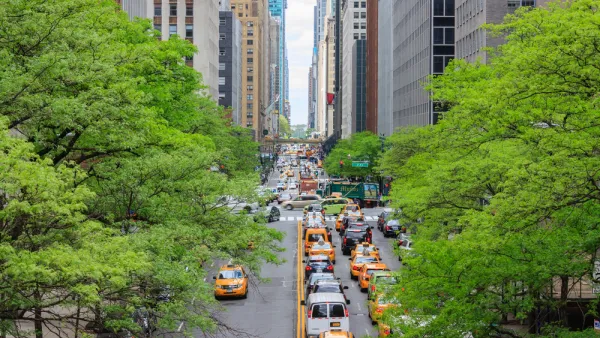
Value Capture Replaces Congestion Pricing as Governor Cuomo's Subway Funding Fix
Gov. Andrew Cuomo (D-N.Y.) appears to be backing away from a controversial plan to toll midtown Manhattan but shows no reservations about embracing land value capture, which some regard as a "taking" by taxing land proximate to subway stations.

Property Tax in Africa
The rapidly growing and urbanizing continent of Africa offers lessons in property tax.

Planetizen Federal Action Tracker
A weekly monitor of how Trump’s orders and actions are impacting planners and planning in America.

The state-sanctioned urbicide of Austin
People don’t kill cities. Freeways do.

US to reduce Colorado River water deliveries to Mexico
A new Colorado Treaty amendment reduces Mexico’s Colorado River water allocation by 250,000 acre feet.

Mamdani overhauls NYC's Vision Zero plan with 100 new policy goals
The overhaul aims to reduce traffic deaths and make streets safer for pedestrians, cyclists and drivers through lower speed limits, new safety infrastructure and more.

Amtrak not solely to blame for New Jersey commuter rail's unreliability, report finds
A new study from the Garden State Initiative found that NJ Transit’s budget grew 20% across a 4 year period, but reliability declined significantly over the same period.

EPA erases limits on planet-warming pollution from power plants
Under Monday’s plan, power plants would still have some limits on how much mercury, arsenic and other contaminants they can emit.

FREE Course: Walkable City 1: Why Walkability?
After describing his path towards focusing on walkability as the essence of good planning, Jeff Speck marches through his five principal reasons for making more walkable places.
Reinventing Malls: Planning Alchemy—Turning Gray Fields Into Gold
The course focuses on the opportunities and imperatives that shape reinvention of mall sites.

Eagle County Government
Harvard University Graduate School of Design
Nashville Planning Department
The Architects Foundation
University of Cincinnati Online
The Pocatello Development Authority
The Urban Renewal Agency of the City of Pocatello
Journal of the American Planning Association