A new cease-and-desist zone, meant to control the activities of house flippers, is under consideration in the Brooklyn neighborhood of East New York, as well as state laws that would increase the real estate transfer tax.


Allison Dikanovic reports on an effort in New York City "to protect homeowners from harassment from real estate speculators by designating the neighborhood as Brooklyn’s only 'cease-and-desist' zone — an area declared off-limits under state law."
"Cease-and-desist protections would allow homeowners to opt into a list restricting would-be house flippers from contacting them — and hit violators with fines, criminal charges or loss of real estate licenses," explains Dikanovic.
The effort so far has the backing of the Coalition for Community Advancement and Democratic State Senator Julia Salazar. The decision to grant "cease-and-desist" powers is held by the state's Department of State, which is holding a public hearing on the proposal this week. The Department of State gained the power to grant "cease-and-desist" status in 1989, but only three neighborhoods in New York City have achieved that status. According to Dikanovic, all three are in suburban-style, largely white and Asian middle-class areas.
"While the Department of State process is underway in East New York, lawmakers in Albany are working on a bill that would make all of Brooklyn a cease-and-desist zone for five years," reports Dikanovic. Advocates are pushing for other methods to counter flipping, like increasing the real estate transfer tax, "which would make it more expensive to re-sell a property within two years of purchasing it," according to Dikanovic. Multiple bills under consideration at the state capital would implement a form of real estate transfer tax.
Read the full story: HARRIED EAST NEW YORK HOMEOWNERS SEEK BAN ON HOUSE FLIPPERS

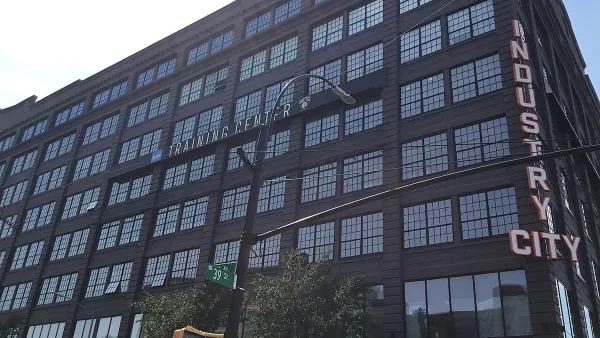
‘Emergent City’ Documentary Highlights Rare Anti-Gentrification Victory
The film charts the saga of a Brooklyn site called Industry City.
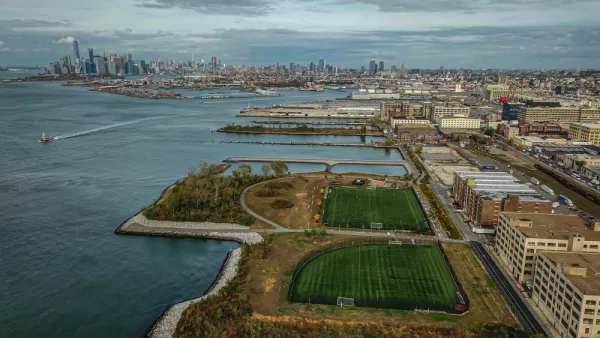
A Planning Showdown in New York City
The proposal to rezone the Industry City redevelopment area in the Sunset Park neighborhood of Brooklyn has won a key approval, but a controversial showdown in the City Council still awaits.
Councilmember Nixes Rezoning Request for Massive Brooklyn Redevelopment Project
Gentrification and displacement concerns won the day over a plan to rezone a former industrial area in Sunset Park, Brooklyn for new retail, offices, hotels and restaurants.

Planetizen Federal Action Tracker
A weekly monitor of how Trump’s orders and actions are impacting planners and planning in America.

California plans to bury El Niño’s downpour
If the state plays its cards right, it may be able to store a billion acre-feet of El Niño’s water in aquifers.

Desperate measures: Advocates weigh draining Lake Powell to fill Colorado River
Draining the reservoir could reduce evaporation losses by a couple hundred thousand acre-feet.

Chicago Avenue bridge construction delays enrages city leaders
The bridge has been closed since 2025. The city originally aimed to re-open it in December, and now expects to finish construction in 2027.

NYC bus network redesign speeds up Queens buses
Rush routes have seen a 4.6% speed increase after the redesign.

California High-Speed Rail Authority picks trainset manufacturer
The California High-Speed Rail Authority aims to start servicing passengers by 2033.

FREE Course: Walkable City 1: Why Walkability?
After describing his path towards focusing on walkability as the essence of good planning, Jeff Speck marches through his five principal reasons for making more walkable places.
Reinventing Malls: Planning Alchemy—Turning Gray Fields Into Gold
The course focuses on the opportunities and imperatives that shape reinvention of mall sites.

City of Rosemead
Rutgers University, Edward J. Bloustein School of Planning and Public Policy
One Hundred Miles
Hunter College, City University of New York (CUNY)
The Architects Foundation
University of Cincinnati Online
City of Cambridge
Montrose County
The Pocatello Development Authority