Decades ago, Bill Fulton wrote that Washington was not a good baseball town—and was skewered by legendary sportswriter Shirley Povich. The World Series made him rethink both D.C. and Houston—as baseball towns and as cities.


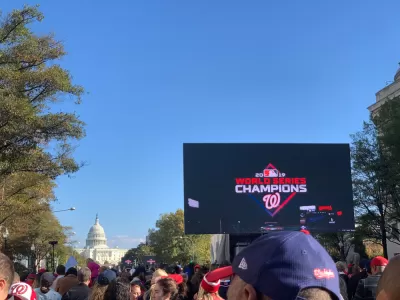
Early in the Reagan Administration, when I was a smarmy young journalist trying to make a name for myself, I wrote a controversial op-ed piece in the Washington Post saying that Washington was not a baseball town and did not deserve its own team. Washington and Baltimore were one region, I argued, and Washington residents should root for the Orioles.
My piece raised the ire of no less than Shirley Povich, the legendary sports columnist for the Post—and father of TV talk show host Maury Povich—who devoted an entire column to trashing me, calling my words “the greatest compendium of flapdoodle ever accepted for the written page.”
I wore Povich’s criticism as a badge of honor for many years. Not only had I gained attention from the famous columnist, but I was secure in the knowledge that, no matter what he claimed, I was right: Washington wasn’t a good baseball town and didn’t deserve a team.
Decades later, as a Houstonian of advanced age, I have to admit that times have changed.
FULL STORY: Washington Is A Graet (Baseball) Town. So IS Houston

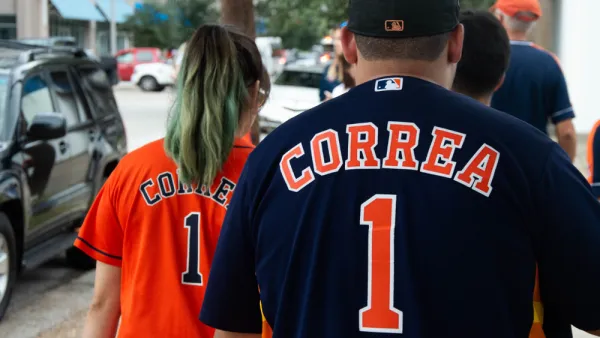
Friday Funny: Zoning Provides Nationals Fans With Another Bragging Point Over Astros Fans
The worlds of baseball and zoning collide again.
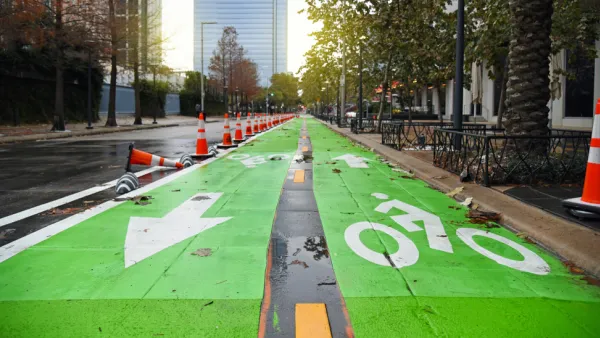
Bike Ridership Booms in Some Unlikely Cities
A fitness tracking app reports dramatic increases in bike ridership since the onset of the coronavirus pandemic.
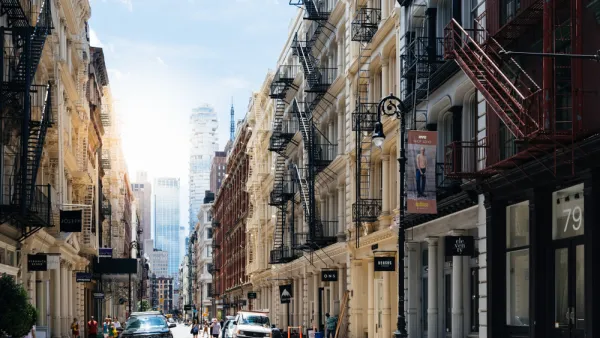
The Growing Urban Inequality Gap, Visualized
Inequality is growing faster in large metropolitan areas, according to a New York Times data visualization.

Planetizen Federal Action Tracker
A weekly monitor of how Trump’s orders and actions are impacting planners and planning in America.

The state-sanctioned urbicide of Austin
People don’t kill cities. Freeways do.

US to reduce Colorado River water deliveries to Mexico
A new Colorado Treaty amendment reduces Mexico’s Colorado River water allocation by 250,000 acre feet.

5 New England states march closer to 800 megawatt wind energy project
Securing federal approval for the project may be complicated under the Trump administration, which has historically been hostile towards domestic wind power.

Baltimore to break ground on $50 million Transit Priority Project
The project will bring faster bus trips, safer streets and better bike connections to Baltimore.

Airbnb launches $250 million 'last-dollar financing' housing accelerator, makes first investment in Austin
The company will put $6.4 million towards affordable housing development in Texas’ capital.

FREE Course: Walkable City 1: Why Walkability?
After describing his path towards focusing on walkability as the essence of good planning, Jeff Speck marches through his five principal reasons for making more walkable places.
Reinventing Malls: Planning Alchemy—Turning Gray Fields Into Gold
The course focuses on the opportunities and imperatives that shape reinvention of mall sites.

Eagle County Government
Harvard University Graduate School of Design
Nashville Planning Department
The Architects Foundation
University of Cincinnati Online
The Pocatello Development Authority
The Urban Renewal Agency of the City of Pocatello
Journal of the American Planning Association