A dive into the concepts and methodologies producing current academic research into the effect of automation of jobs in the urban planning field.




Automation is a hot topic in the United States today. Controversy and discrepancies surround the discussion at every point, even down to what the word automation means.
In general terms, automation refers to the use of mechanized equipment in a system or process. It's currently prevalent in manufacturing, where artificial intelligence (AI) and robots are used to streamline the process of creating goods. Aside from production, there is a push to apply automation technology across a multitude of career fields.
AI and robotic automation are already integrated into everyday life in America, and the use of these technologies will only increase from here. For example, smartphones are AI devices that automate different aspects of someone's day.
In 2018, some 1.56 billion smartphones were sold worldwide, and there are 237.5 million smartphone users in the United States alone. Automation is prevalent throughout the average American's personal life. The question is: where will it stop?
What Jobs Will Automation Affect?
Although most jobs can be automated in one way or another, job security might depend more upon geography than industry.
Researchers from the Massachusetts Institute of Technology (MIT) found that there is a correlation between the size of a city and the impact that AI and robotic automation will have upon the workforce. In general, cities of 100,000 people or less will be at a higher risk of unemployment from robotics than people of larger cities.
Areas that are heavily reliant upon agriculture could see immense automation. However, a city like San Francisco might not, because its economy is centered on technology and innovation.
Washington, D.C., on the other hand, could see between 27%-47% of government jobs automated. While many of the jobs in D.C. are government-related and, therefore, unable to be outsourced to a computer, there are still plenty of opportunities for automation to deplete some of the government workforce. Although automation will likely cause some level of unemployment in the future, it will not eradicate all positions across the country.
Automation is already in place t the ATM. When they first hit the market, it was thought that ATMs would end bank tellers' jobs around the world. However, ATMs made it easier for banks to open more branches, which created more positions.
Similarly, grocery stores created self-checkouts, which allowed customers to buy items on their own. It was expected that cashier jobs would be removed, but they were not. There are also attendants monitoring self-checkout areas. Automation is meant to improve systems and processes, not eliminate jobs.
Are Urban Planning Jobs in Danger?
Urban planning is the creation and implementation of comprehensive plans and programs for the use of land and physical facilities in towns, cities, counties and metropolitan areas. Planners meet with public officials regarding development plans, study the use of property, gather and analyze data from market research, review land proposals, and present projects to review boards and other entities.
The main job of urban planners is to identify community needs and develop short- and long-term solutions to current problems in communities. They use statistical software, data and presentation programs, and design software, among other tools, as part of their work.
There are parts of an urban planner's job that could be automated, but given that urban planners collaborate with multiple outside sources, it would be difficult to automate the job entirely.
However, if AI and robotics continue to develop and learn at a human capacity, urban planning could face more of a threat. Machines would have the ability to quickly calculate the best way to allocate space, measure distances, and design spaces that would take a person significantly longer.
However, the most likely outcome is one of collaboration. Urban planners will use AI and robotics to calculate plans quicker and more efficiently than ever before. They will adjust them for the specific needs of the community they are building up.
Potential Downfalls of Automation in Urban Planning
The difficulty with automation is developing the ability of a robot to solve a problem. As cities and metropolitan areas grow and infrastructure becomes more complex, issues will arise that require complex solutions. AI may create a perfect plan for a town, but other things could come up.
Urban planners will be required to present and monitor projects from start to finish. They will have to adjust them based on zoning and city restrictions. Automation will act as a tool that assists planners, but it is unlikely that AI will completely replace the profession.
Urban planners also play a role in government planning in cities. Their involvement in contracting adds another nuance to the job that would be difficult to automate.
Regulatory compliance requirements are increasing in regard to governmental contracts. One of the new requirements is from the Department of Defense, focusing on the contractor's internal research and development as an element of bid evaluations for competitive purposes and including major automated information system programs. Independent research and development (IR&D) expenses will see a substantial increase in cost due to this new regulation.
The government's Better Buying Power 3.0 initiative is seeking to level the playing field by evaluating all IR&D expenses uniformly. Companies relying upon AI automated systems will now be assessed accordingly, and it levels the playing field for companies that rely on urban planners to create bids for government contracts.
Automation Is the Future
Automation is an exciting prospect for the future of every industry, but it's still an area of concern for the U.S. economy.
Automation will undoubtedly take jobs away from Americans in some form, but it will also create new ones. It should be viewed as a powerful tool that can improve multiple facets of business and personal life, not as the terminator of people's jobs.

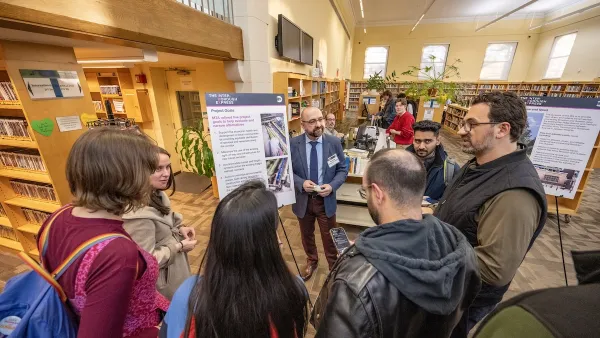
Will Urban Planners Lose Their Jobs to AI?
Let’s see what the data says.

Social Media Bots and the Community Planning Process
Recently published research examines the "Role of Artificial Intelligence in Community Planning"—that is, the role of automated bots on social media in corrupting participatory planning processes.
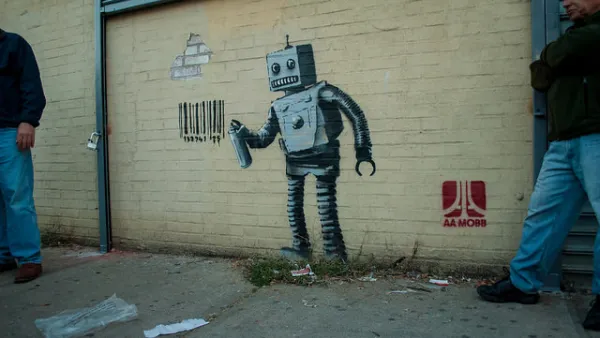
6 Ways Robots Are Changing City Planning and Development
Of course artificial intelligence has applications relevant to the practice of city planning.

Planetizen Federal Action Tracker
A weekly monitor of how Trump’s orders and actions are impacting planners and planning in America.

California plans to bury El Niño’s downpour
If the state plays its cards right, it may be able to store a billion acre-feet of El Niño’s water in aquifers.

Desperate measures: Advocates weigh draining Lake Powell to fill Colorado River
Draining the reservoir could reduce evaporation losses by a couple hundred thousand acre-feet.

Chicago Avenue bridge construction delays enrages city leaders
The bridge has been closed since 2025. The city originally aimed to re-open it in December, and now expects to finish construction in 2027.

NYC bus network redesign speeds up Queens buses
Rush routes have seen a 4.6% speed increase after the redesign.

California High-Speed Rail Authority picks trainset manufacturer
The California High-Speed Rail Authority aims to start servicing passengers by 2033.

FREE Course: Walkable City 1: Why Walkability?
After describing his path towards focusing on walkability as the essence of good planning, Jeff Speck marches through his five principal reasons for making more walkable places.
Reinventing Malls: Planning Alchemy—Turning Gray Fields Into Gold
The course focuses on the opportunities and imperatives that shape reinvention of mall sites.

City of Rosemead
Rutgers University, Edward J. Bloustein School of Planning and Public Policy
One Hundred Miles
Hunter College, City University of New York (CUNY)
The Architects Foundation
University of Cincinnati Online
City of Cambridge
Montrose County
The Pocatello Development Authority

