The Los Angeles Times published a massively ambitious account of the sea-level threat facing California.


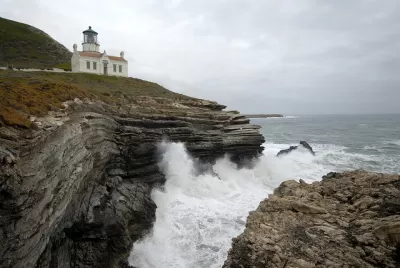
California's golden era of growth and prosperity, which started in the 19th century by lasted throughout much of the 20th century, occurred during a "rare confluence of favorable winds and cooler water," according to the context for a massive new feature on sea-level rise in California, penned by Rosanna Xia.
Now California has to come to terms with reality. "In the last 100 years, the sea rose less than 9 inches in California. By the end of this century, the surge could be greater than 9 feet."
The massive feature includes deep dives on specific case studies along the cost, like in Pacifica, which has already been forced to undertake a controversial strategy of managed retreat. Xia also details the environmental impacts seawalls. While some argue that seawalls can save coastal cities, environmentalists call them a coastal crisis. States like Oregon, North Carolina, and Maine have imposed serious restrictions on them. In San Francisco, the placement and replenishment of seawalls will reflect hard choices about which parts of the city can survive a large storm event, and the ensuing floods. There are more sections on beach replenishment, managed retreat, and a town that has already begun to slip into the ocean.
There's also an interactive game included in this sea-level and climate change extravaganza, which allows users to play at planner and make choices that can either save or doom a town from sea-level rise.
Read the full story: The California coast is disappearing under the rising sea. Our choices are grim
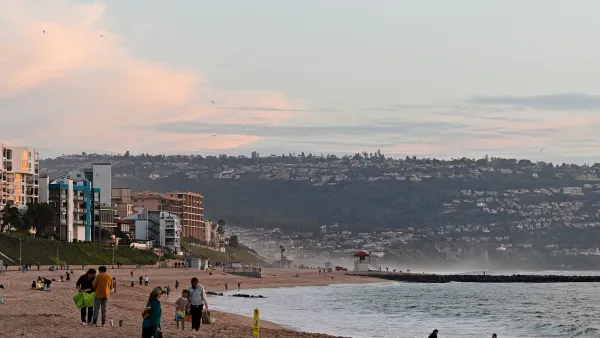
California may destroy its beaches trying to save homes from El Niño
Boulders and seawalls can protect homes from waves, but ultimately destroy sandy beaches.
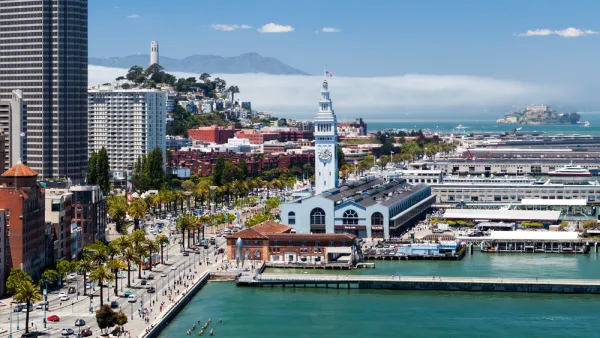
Port of San Francisco, Army Corps of Engineers Planning for Rising Bay Waters
A massive climate adaptation planning effort is underway for the docks (and seawalls and landfill) of the San Francisco Bay.
Report: Embarcadero Needs to Rise 7 Feet to Resist Sea-Level Rise
A bombshell report details the adaptation measures that will be necessary to keep San Francisco's Embarcadero high and dry as the climate changes and sea levels rise.

Planetizen Federal Action Tracker
A weekly monitor of how Trump’s orders and actions are impacting planners and planning in America.

California plans to bury El Niño’s downpour
If the state plays its cards right, it may be able to store a billion acre-feet of El Niño’s water in aquifers.

Desperate measures: Advocates weigh draining Lake Powell to fill Colorado River
Draining the reservoir could reduce evaporation losses by a couple hundred thousand acre-feet.

US buildings threatened, destroyed by fires set to triple by 2060
Researchers found a high fire risk for socioeconomically vulnerable neighborhoods in the American West.

LA residents may be allowed to paint their own crosswalks
Councilwoman Katy Yaroslavsky put out a motion instructing the Los Angeles Department of Public Transportation to study the feasibility of allowing volunteers to paint crosswalks.

Dallas moves to overhaul its zoning code
The city's zoning reform will allow more multi-family and mixed-use developments.

FREE Course: Walkable City 1: Why Walkability?
After describing his path towards focusing on walkability as the essence of good planning, Jeff Speck marches through his five principal reasons for making more walkable places.
Reinventing Malls: Planning Alchemy—Turning Gray Fields Into Gold
The course focuses on the opportunities and imperatives that shape reinvention of mall sites.

City of Rosemead
Rutgers University, Edward J. Bloustein School of Planning and Public Policy
One Hundred Miles
Hunter College, City University of New York (CUNY)
The Architects Foundation
University of Cincinnati Online
City of Cambridge
Montrose County
The Pocatello Development Authority