"Leftover lots" are the object of one Philadelphia-based architecture firm's fascination.



Jake Blumgart details the work of the architecture firm ISA, which designs "a new generation of uniquely Philadelphian homes […] as architects confront a dwindling supply of available land in growing neighborhoods and seek ways to squeeze housing into what architect Brian Phillips, founding principal of the firm ISA, calls the 'leftover lots' — the alleys, the side yards, and yes, the courtyards."
ISA is behind an exhibition that debuted yesterday to celebrate rowhouses, which Blumgart calls "the city’s most ubiquitous housing typology." In May, ISA won a 2019 AIA Housing Award for the Tiny Tower, a "slender new take on the "old old Philly row."
"ISA’s tower stands on a narrow back street of Brewerytown, a North Philadelphia neighborhood that’s experienced extensive reinvestment in recent years. Rowhomes line the west end of the block, but vacant lots surround the ISA lot, on the southeastern portion of the block. The roadway is so tight that cars must ease down it, creating a nice quiet block sheltered from bustling Girard Avenue to the immediate north."
Read the full story: These architects want to build a house in your alley

Video: A ‘European-Style’ Street in Philadelphia
With its narrow lanes and mature trees, Philadelphia’s Quince Street illustrates what’s possible.

How Effective are Philadelphia’s Keystone Opportunity Zones?
The impacts of a tax break designed to create jobs, stimulate development, and reduce blight are proving hard to track.
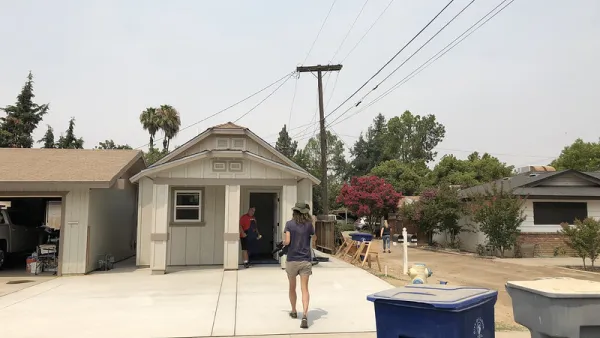
Pre-Approved ADUs Now Available in Sacramento
The city of Sacramento is making it easier to develop accessory dwelling units.

Planetizen Federal Action Tracker
A weekly monitor of how Trump’s orders and actions are impacting planners and planning in America.

California plans to bury El Niño’s downpour
If the state plays its cards right, it may be able to store a billion acre-feet of El Niño’s water in aquifers.

Desperate measures: Advocates weigh draining Lake Powell to fill Colorado River
Draining the reservoir could reduce evaporation losses by a couple hundred thousand acre-feet.

Los Angeles just elected an urban planner as its mayor
Transportation analysts are optimistic that Raman will be more aggressive in addressing transit issues than Bass.

Mamdani’s pied-à-terre tax survives legal challenge
A panel of judges found that the plaintiffs failed to demonstrate injury as a result of New York City's implementation of the tax.

Eastern Nebraska is running out of electricity
Data centers and electrification are straining eastern Nebraska’s grid, throttling economic development.

FREE Course: Walkable City 1: Why Walkability?
After describing his path towards focusing on walkability as the essence of good planning, Jeff Speck marches through his five principal reasons for making more walkable places.
Reinventing Malls: Planning Alchemy—Turning Gray Fields Into Gold
The course focuses on the opportunities and imperatives that shape reinvention of mall sites.

City of Rosemead
Rutgers University, Edward J. Bloustein School of Planning and Public Policy
One Hundred Miles
University of Michigan School for Environment and Sustainability (SEAS)
Hunter College, City University of New York (CUNY)
The Architects Foundation
City of Cambridge
Montrose County
The Pocatello Development Authority