A new 3D printer, coming soon to the market, promises serious construction cost savings in an era of seriously expensive construction costs.


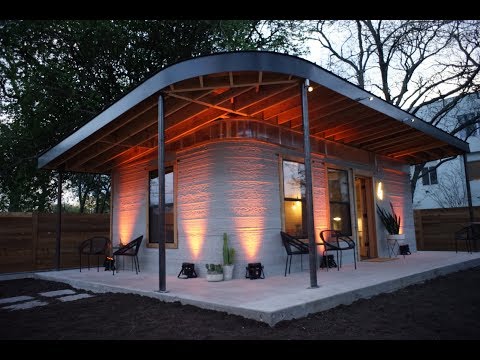
Cindy Widner reports on the expanding legacy of the first fully permitted 3D-printed home in the United States—a 350-square-foot home located in East Austin.
The home required 48 hours of printing, and was unveiled in March 2018.
"The house was the result of a collaboration between Austin-based Icon, a startup focused on creating new, sustainable building practices to make quality homes accessible to all, and New Story, a nonprofit dedicated to building low-cost homes internationally," according to Widner.
The home is back in the news this week, during South by Southwest, as Icon announces that its new printer, the Vulcan II 3D printer, will be shipped to "first-end users" in April of this year.
Austin-based Cielo Property Group has commissioned a Vulcan II printer, according to Widner, "to be used exclusively to print affordable housing locally."
Icon promises cost savings of 30-50 percent from traditional construction techniques.
Read the full story: 3D-printed Austin house becomes international model

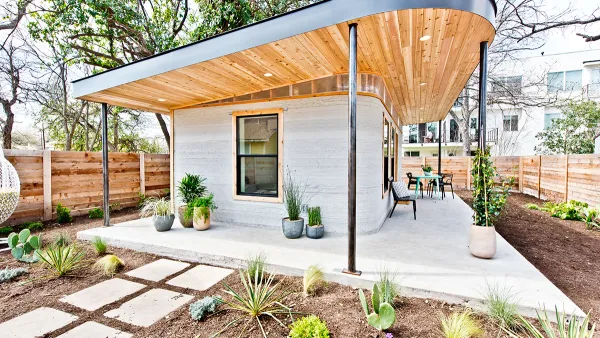
Coming Soon: A 3D-Printed Neighborhood
The march of progress continues.

World's Largest 3D-Printed Community Planned In Austin
The process aims to reduce labor hours and material waste, dramatically cutting construction costs for new housing.
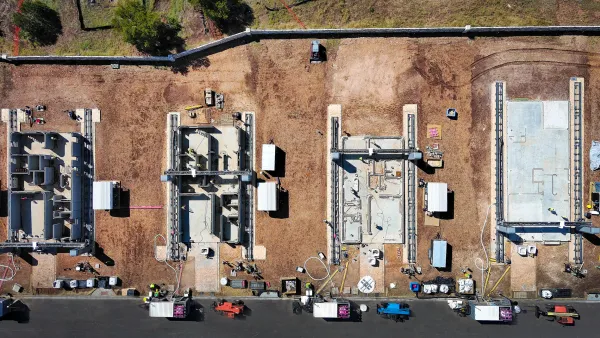
3D-Printed Community in Texas Nearly Complete
Upon completion, the 100-home Wolf Ranch Community north of Austin will be the largest 3D printed neighborhood in the world.

Planetizen Federal Action Tracker
A weekly monitor of how Trump’s orders and actions are impacting planners and planning in America.

California plans to bury El Niño’s downpour
If the state plays its cards right, it may be able to store a billion acre-feet of El Niño’s water in aquifers.

Chicago breaks ground on $3 billion megadevelopment
The new neighborhood, titled Foundry Park, will one day host 3,700 residences.

Satanic Place Names
From streams and lakes to valleys and canyons, I mapped more than 1,000 places named after the Devil.

California High-Speed Rail Authority CEO resigns after $600,000 scandal
Under Ian Choudri, the authority used taxpayer dollars to fund first class flights and trips to nightclubs.

Want to study the Missouri River? Soon, you may need unanimous approval from 10 states
Legislation would require 10 governors’ permission to study or build projects moving water outside the basin.

FREE Course: Walkable City 1: Why Walkability?
After describing his path towards focusing on walkability as the essence of good planning, Jeff Speck marches through his five principal reasons for making more walkable places.
Reinventing Malls: Planning Alchemy—Turning Gray Fields Into Gold
The course focuses on the opportunities and imperatives that shape reinvention of mall sites.

City of Rosemead
Rutgers University, Edward J. Bloustein School of Planning and Public Policy
One Hundred Miles
Hunter College, City University of New York (CUNY)
The Architects Foundation
University of Cincinnati Online
City of Cambridge
Montrose County
The Pocatello Development Authority