Democrats and transportation advocates are responding to the Trump administration’s plans to overhaul the Capital Investment Grants program.



Since President Trump began his second term, his administration has awarded just one grant from the multibillion-dollar Capital Investment Grants program, writes Emily Badger for the New York Times. The grants are intended to help communities build rail and bus projects. The Trump administration previously tried to eliminate the grant program; now, transit officials and advocates “fear the administration is squeezing the program instead,” The New York Times reports.
The White House has pushed over $5 billion in CIG funds that could have been spent immediately to fiscal year 2028. It also released a proposal to overhaul CIG’s rules in ways that “could make it harder for communities to secure grants and, ultimately, to take on complex construction projects they can’t afford on their own,” Badger reports. The Federal Transit Administration says the changes are intended to streamline and improve the program.
The New York Times reports:
“Because of the large number of disruptive and unsound elements of the proposed policy guidance, we must consider if F.T.A.’s intent is to undermine the C.I.G. program and discourage future applicants,” wrote the top Democrats on committees overseeing the program and its funding, the senators Elizabeth Warren and Patty Murray and Representative Rick Larsen, in a letter to the F.T.A. and White House budget director this week.
“You reach a pretty logical conclusion that this administration is trying to eliminate funding provided by Congress for transit projects,” said Steve Davis, director of the advocacy group Transportation for America. “And who’s going to suffer? Americans in cities of all sizes just trying to catch the bus to work.”
Read the full story: A New Trump Tactic to Restrict Transit Funding: Rewrite the Rules

APTA files formal complaint against FTA
The association has asked the Federal Transit Authority to immediately withdraw its new guidance surrounding Capital Investment Grants.
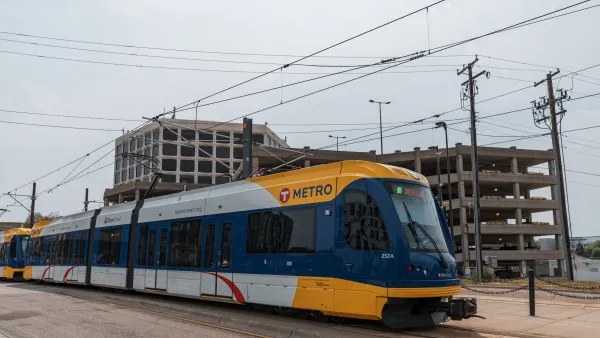
Two Years In, a Look at the Twin Cities Fare Discount Program
In 2017, Metro Transit in the Twin Cities raised fares but also started a program for low-income riders to help ease the burden of travel costs.
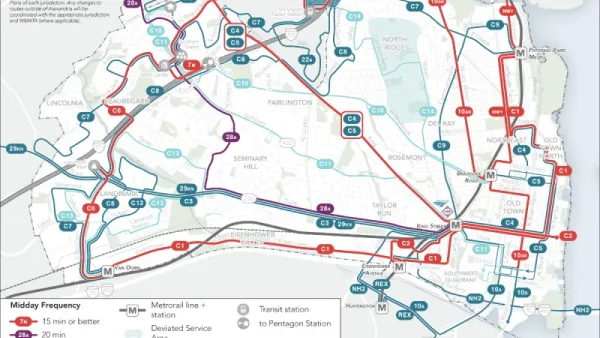
Ridership Down for Northern Virginia Public Transit
Metrorail has seen ridership improve in Northern Virginia, but not enough to balance out the losses to bus ridership.

Planetizen Federal Action Tracker
A weekly monitor of how Trump’s orders and actions are impacting planners and planning in America.

Washington state to charge fee to drivers with fuel-efficient cars
Revenue from the fee will go towards supporting the state’s highways.

Illinois considers spending $1 billion in taxpayer money on data center
A quantum computing campus and data center are currently under construction in Chicago.

Mamdani to replace Rikers Island with four borough-based jails
The four new jails are set to open between 2029 and 2032.

NYC may allow residents to ‘adopt’ storm drains
A new proposal would establish a volunteer program where residents could help clean debris from storm drains.

‘A price cannot be put on democracy:’ Local leaders protest UMich data center
The 1.25 billion-dollar project would take up 144 acres of land in Ypsilanti Township.

FREE Course: Walkable City 1: Why Walkability?
After describing his path towards focusing on walkability as the essence of good planning, Jeff Speck marches through his five principal reasons for making more walkable places.
Reinventing Malls: Planning Alchemy—Turning Gray Fields Into Gold
The course focuses on the opportunities and imperatives that shape reinvention of mall sites.

City of Charlotte
City of Rosemead
Rutgers University, Edward J. Bloustein School of Planning and Public Policy
University of Michigan School for Environment and Sustainability (SEAS)
Hunter College, City University of New York (CUNY)
The Architects Foundation
University District Partnership