Somerville is embracing ‘extreme street makeovers’ to make its roads safer for pedestrians and cyclists.


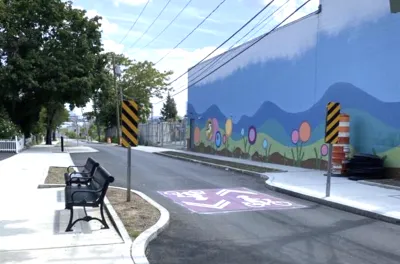
In just a few days, Tufts Street in Somerville is going to get much harder to drive on: its wide, linear road will finish its transformation into a winding path with speed humps and artificially narrowed sections. While the changes may seem unorthodox, Somerville is purposefully filling this road with obstacles to slow down traffic and make the street safer for pedestrians.
“[Tufts Street is] a ‘neighborway,’ one of several experiments in extreme street makeovers in Somerville as the city tries to prevent deadly crashes on its roads by intentionally making it harder to drive on them, turning side streets into comfortable routes for people who aren’t traveling by car, and cutting down on the risk posed by too many cars going too fast,” Spencer Buell writes for the Boston Globe.
The term “neighborway” describes roads where drivers move so carefully that kids can ride their bikes in the street. Somerville’s neighborways has not always gone over well with drivers, but the city has seen results from its embrace of pedestrian-friendly infrastrcuture: Somerville has not has a single traffic death in four years.
Read the full story: Somerville is intentionally making roads harder to drive on. It’s getting results.

Massachusetts town celebrates 3 years with no traffic deaths
Somerville is following Hoboken's Vision Zero playbook with impressive results.
New England's densest city celebrates 4 years with no traffic deaths
A Boston suburb has achieved — and maintained — Vision Zero results "almost unheard of in any urban area."
Landscapes of love and loss
As urban planners, every piece of infrastructure we build is a memorial — whether we know it or not.

Planetizen Federal Action Tracker
A weekly monitor of how Trump’s orders and actions are impacting planners and planning in America.

‘Going backwards:’ Baltimore mayor, students rally against state's transit funding plan
Maryland's proposed six-year plan provides no funding for Baltimore’s BMORE bus program and reduces its road maintenance funding.

Detroit to transform waterfront with $2.2 billion investment
Developers will convert about 18 acres of unused parking lot space into civic spaces.

HUD modernizes 50-year-old manufactured housing framework
The Next Generation Manufactured Housing Action Plan establishes new energy-efficiency standards for manufactured homes, and new guidelines for anchoring them.

New CA housing laws tear down development red tape
Recently-signed legislation makes building starter homes and ADUs cheaper and faster in California.

Metrolink finishes first expansion in 20 years
The transit agency is now one of very few in the United States to connect two major airports.

FREE Course: Walkable City 1: Why Walkability?
After describing his path towards focusing on walkability as the essence of good planning, Jeff Speck marches through his five principal reasons for making more walkable places.
Reinventing Malls: Planning Alchemy—Turning Gray Fields Into Gold
The course focuses on the opportunities and imperatives that shape reinvention of mall sites.

One Hundred Miles
County of Mendocino
planning NEXT
The Architects Foundation
University of Cincinnati Online
Montrose County
Northern Illinois Transit Authority (NITA)
The Pocatello Development Authority