Whether circular or linear, the shape and layout of cities affects how their residents get around.



An article from Complexity Science Hub highlights new research that reveals that the shape of cities has a significant impact on how people move around them. "Urbanization matters on many fronts, including sustainability: according to the International Energy Agency, cities account for roughly 75% of the global energy use and 70% of greenhouse gas emissions."
According to the article, "The results confirm that a compact and round city shape benefits travel efficiency. Elongated layouts that stretch along one axis increase travel distance in a non-linear fashion. Vienna, which was used as a reference for the model, is moderately elliptical and has an average travel distance of just under 10 km."
As the article notes, "Moderately pyramid-shaped profiles alone can lower travel distances by 20-25% compared to flat layouts, as taller buildings in the center bring potential origin and destination points closer together, thereby yielding substantial efficiency gains."
Moreover, "While city morphology is often subject to constraints (geographical, political, and those imposed by past decisions), the study shows that understanding the impact of city shapes creates opportunities for planning more equitable, resilient, and sustainable urban habitats."
FULL STORY: Why we need to consider city shapes to save energy, water, and the climate

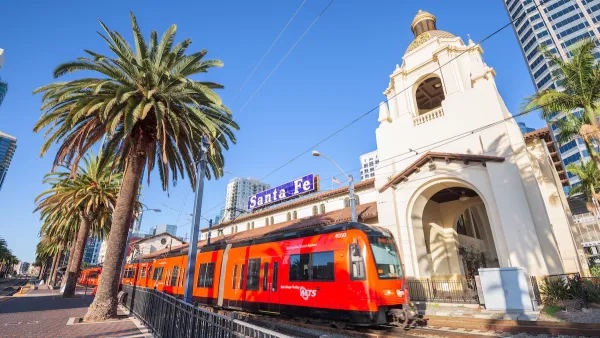
San Diego Region Developing Long-Range Transportation Plan
The new plan, set to take effect in 2025, accounts for changes in mobility patterns brought on by remote work.
Redesigning Cities for Better Mobility
A new project aimed at reducing car reliance in world cities has paired ten architects with ten cities to create a redesigned public space that encourages a mix of transit modes.
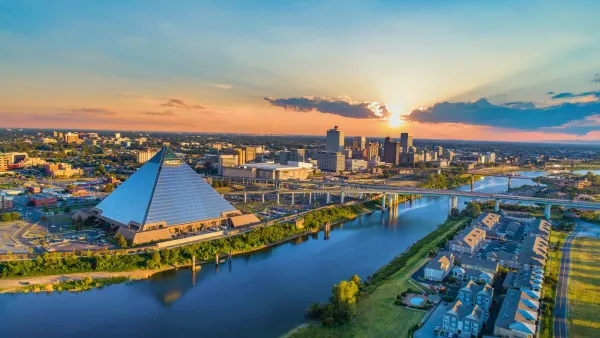
15 US cities and their global namesakes
Hundreds of cities around the United States are named after other places. We tour a few of them.

The state-sanctioned urbicide of Austin
People don’t kill cities. Freeways do.

US to reduce Colorado River water deliveries to Mexico
A new Colorado Treaty amendment reduces Mexico’s Colorado River water allocation by 250,000 acre feet.

New Jersey’s second-largest city bans standalone data centers
Jersey City will continue to allow co-location facilities, such as those meant for research institutions that store their own data.

Amtrak not solely to blame for New Jersey commuter rail's unreliability, report finds
A new study from the Garden State Initiative found that NJ Transit’s budget grew 20% across a 4 year period, but reliability declined significantly over the same period.

EPA erases limits on planet-warming pollution from power plants
Under Monday’s plan, power plants would still have some limits on how much mercury, arsenic and other contaminants they can emit.

Phoenix announces new on-demand transit service, more frequent RAPID buses
Both new services will launch in October, and are part of Phoenix's Project Effective Access Solutions for Easing Congestion.

FREE Course: Walkable City 1: Why Walkability?
After describing his path towards focusing on walkability as the essence of good planning, Jeff Speck marches through his five principal reasons for making more walkable places.
Reinventing Malls: Planning Alchemy—Turning Gray Fields Into Gold
The course focuses on the opportunities and imperatives that shape reinvention of mall sites.

Eagle County Government
Harvard University Graduate School of Design
Nashville Planning Department
The Architects Foundation
University of Cincinnati Online
The Pocatello Development Authority
The Urban Renewal Agency of the City of Pocatello
Journal of the American Planning Association