The bill also calls for an impact report from the state's environmental agency and public hearings for large data center proposals.


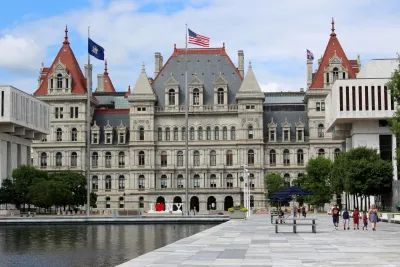
If Gov. Kathy Hochul signs a bill passed by the state legislature last week, New York could become the first state to temporarily ban new data centers statewide, reports Lauren Feiner in The Verge.
The legislature passed the one-year moratorium to give policymakers time to understand the impacts of data centers on communities and the environment and to develop regulations. "It directs the state’s environmental agency to create an impact report assessing the amount of electricity, water, and land that data centers use, and the pollution they create. It also requires companies planning to build large data centers — defined as having a peak demand of at least 20 megawatts — to hold and fund a public hearing at least three months before it’s able to gain approval for the project."
Industry groups oppose the bill, with Stacey Sikes, acting president and CEO of the Long Island Association, saying that the ban would "overall be damaging to the state’s economy, because having a blanket moratorium instead of looking at it at a case by case basis would not allow the state to move forward on a data center project that would actually be helpful to our economy."
FULL STORY: New York lawmakers pass one-year ban on new data centers

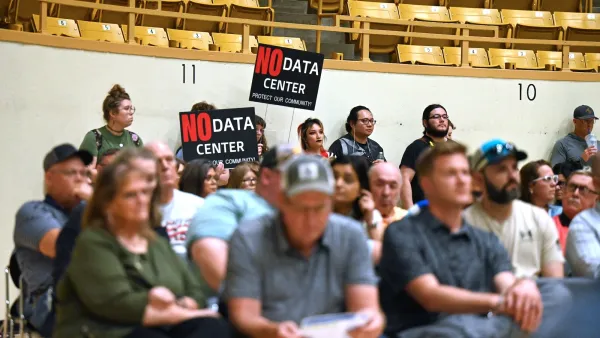
Poll: 75% of Americans oppose data centers near their homes
As they proliferate across the country, data centers face growing backlash from communities concerned about their rapid growth and unknown impacts.
Seattle bans data centers for a year
The city council approved the measure after five 'mystery' projects raised concerns among residents and city leaders.
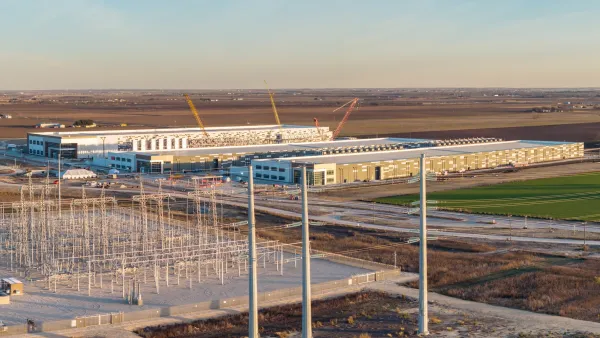
Texas bars data centers from raising utility costs for residents
Gov. Abbott is calling on the state's utility regulator to take steps to reduce energy costs for consumers and ensure data center operators pay for any added costs.

Planetizen Federal Action Tracker
A weekly monitor of how Trump’s orders and actions are impacting planners and planning in America.

The state-sanctioned urbicide of Austin
People don’t kill cities. Freeways do.

US to reduce Colorado River water deliveries to Mexico
A new Colorado Treaty amendment reduces Mexico’s Colorado River water allocation by 250,000 acre feet.

5 New England states march closer to 800 megawatt wind energy project
Securing federal approval for the project may be complicated under the Trump administration, which has historically been hostile towards domestic wind power.

Baltimore to break ground on $50 million Transit Priority Project
The project will bring faster bus trips, safer streets and better bike connections to Baltimore.

Airbnb launches $250 million 'last-dollar financing' housing accelerator, makes first investment in Austin
The company will put $6.4 million towards affordable housing development in Texas’ capital.

FREE Course: Walkable City 1: Why Walkability?
After describing his path towards focusing on walkability as the essence of good planning, Jeff Speck marches through his five principal reasons for making more walkable places.
Reinventing Malls: Planning Alchemy—Turning Gray Fields Into Gold
The course focuses on the opportunities and imperatives that shape reinvention of mall sites.

Eagle County Government
Harvard University Graduate School of Design
Nashville Planning Department
The Architects Foundation
University of Cincinnati Online
The Pocatello Development Authority
The Urban Renewal Agency of the City of Pocatello
Journal of the American Planning Association