Public seating can be an indicator of broader trends in who gets to use public space — and how.


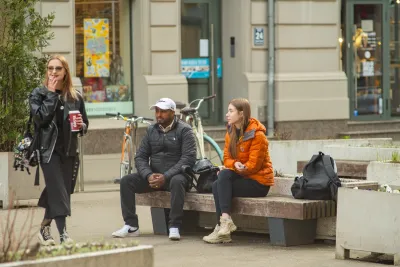
Public seating is disappearing from transit stations, parks, plazas, and sidewalks around the country, writes Gabrielle Bruney in a piece for Places Journal.
For Bruney, "Benches are microcosms of an expansive debate about who belongs in urban public spaces. When they are removed or made uninviting, we lose more than just a place to rest." Seating serves a range of constituencies with different needs and are "symbols of hospitality, an invitation to participate in the civic realm." When we lose benches, we lose a certain relationship with public space that invites us to linger.
Bruney highlights New York City's Moynihan Train Hall, a much-lauded new transit station built in the city's former main post office. For all its soaring glass ceilings and art installations, the hall notably lacks seating. In the effort to prevent unhoused people from using public amenities, cities often deprive all citizens of basic public goods.
Bruney's piece provides an expansive history of public benches and their role as places of inclusion or exclusion, as well as the concept of POPS, "privately owned public spaces" that are required by governments, through various agreements, to offer public access and amenities.
FULL STORY: The Disappearance of the Public Bench

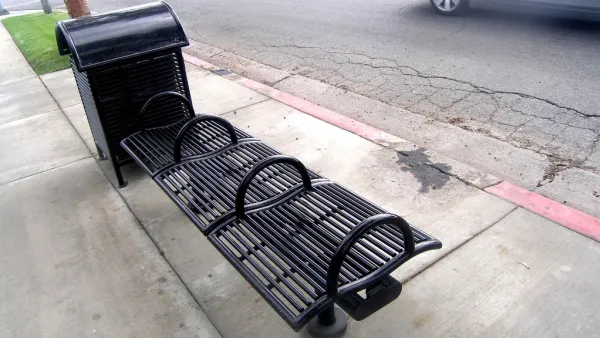
Op-Ed: Public Seating Is for Everyone
Seating in the public realm often isn’t designed to accommodate varied body types, ages, and abilities.
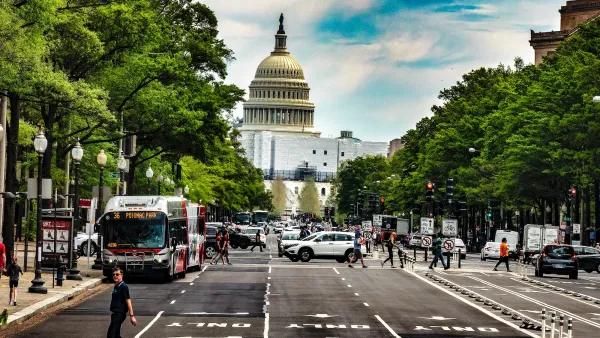
'America's Main Street' could get a people-friendly makeover
Washington, D.C. officials are evaluating a redesign of Pennsylvania Avenue that would increase public seating and prioritize views of the Capitol.

One Year Into Brazil’s ‘Hostile Architecture’ Ban
A recent law prohibits ‘defensive’ architecture designed to keep people away from buildings or public spaces.

The state-sanctioned urbicide of Austin
People don’t kill cities. Freeways do.

US to reduce Colorado River water deliveries to Mexico
A new Colorado Treaty amendment reduces Mexico’s Colorado River water allocation by 250,000 acre feet.

New Jersey’s second-largest city bans standalone data centers
Jersey City will continue to allow co-location facilities, such as those meant for research institutions that store their own data.

Amtrak not solely to blame for New Jersey commuter rail's unreliability, report finds
A new study from the Garden State Initiative found that NJ Transit’s budget grew 20% across a 4 year period, but reliability declined significantly over the same period.

EPA erases limits on planet-warming pollution from power plants
Under Monday’s plan, power plants would still have some limits on how much mercury, arsenic and other contaminants they can emit.

Phoenix announces new on-demand transit service, more frequent RAPID buses
Both new services will launch in October, and are part of Phoenix's Project Effective Access Solutions for Easing Congestion.

FREE Course: Walkable City 1: Why Walkability?
After describing his path towards focusing on walkability as the essence of good planning, Jeff Speck marches through his five principal reasons for making more walkable places.
Reinventing Malls: Planning Alchemy—Turning Gray Fields Into Gold
The course focuses on the opportunities and imperatives that shape reinvention of mall sites.

Eagle County Government
Harvard University Graduate School of Design
Nashville Planning Department
The Architects Foundation
University of Cincinnati Online
The Pocatello Development Authority
The Urban Renewal Agency of the City of Pocatello
Journal of the American Planning Association