RIPTA’s Flex On Demand program replaces scheduled stops on some of its bus lines with a curb-to-curb microtransit service.


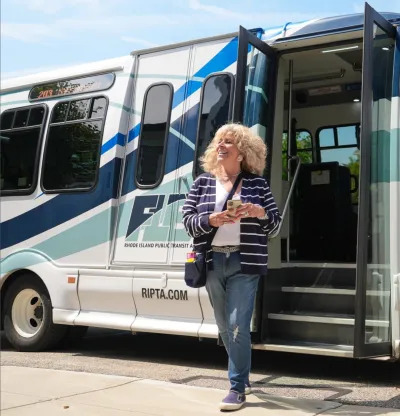
The Rhode Island Public Transit Authority (RIPTA) is expanding its on-demand microtransit program to new communities, reports Leah Crowley for WPRI Providence. The Flex On Demand program supplements RIPTA’s other transit options with fully ADA-accessible, curb-to-curb service at a flat rate of $2 per ride.
“Rather than having a full-size bus running on a set schedule, efficient Flex vans offer service when you need it, which was extremely successful during our initial pilot in South County,” said RIPTA CEO Christopher Durand in a press release.
Crowley notes that “With the addition of the flexible ride option, RIPTA will be eliminating scheduled stops on the Flex 204 and Flex 231 routes.” Riders can reserve a ride through a mobile app or by calling a phone number.
Read the full story: RIPTA expands rideshare-style transit program with free first round-trip ride


West Memphis to launch new transit system
The city across the Mississippi River from Memphis, Tennessee will soon begin service on its own, on-demand transit system.

El Paso launches improved bus network, new microtransit service
Sun Metro is eliminating some bus lines in favor of more frequent service, estimating that only 1% of riders will have to walk farther to reach a station.

South Florida Microtransit Nears 1.5 Million Rides
Fort Lauderdale’s LauderGO! shuttle service reported 700,000 rides.

Planetizen Federal Action Tracker
A weekly monitor of how Trump’s orders and actions are impacting planners and planning in America.

Amtrak, CN end decades-long dispute with eight-year agreement
The new operating agreement establishes an updated framework for the companies to work together, including processes to resolve disputes.

Judges permit Denver to divert 77,000 acre feet from the Colorado River for reservoir expansion
Overuse and climate change have caused the Colorado River’s water levels to plummet.

NYC DOT wants faster, more permanent street upgrades
The city is examining ways to build more concrete infrastructure without getting entangled in 'decades-long' projects.

'Something we’ve never seen before:' rising utility rates could strain city finances nationwide
Data centers, climate change and other factors have caused utility rates in the United States to increase by 38% since 2020.

Trump to overrule local leaders, lease millions of acres of America’s Pacific Island territories’ seafloors to mining companies
International law says that the Indigenous people of America’s territories have a right to prior and informed consent regarding projects that impact their countries.

FREE Course: Walkable City 1: Why Walkability?
After describing his path towards focusing on walkability as the essence of good planning, Jeff Speck marches through his five principal reasons for making more walkable places.
Reinventing Malls: Planning Alchemy—Turning Gray Fields Into Gold
The course focuses on the opportunities and imperatives that shape reinvention of mall sites.

Harvard University Graduate School of Design
KFH Group Inc.
Greater Baltimore Committee
The Architects Foundation
University of Cincinnati Online
The Pocatello Development Authority
The Urban Renewal Agency of the City of Pocatello