Imperial County residents and local officials oppose two proposed data centers that would significantly impact natural resources.



Residents of California’s Imperial Valley are protesting a series of proposed data centers that could dramatically change the landscape of the mostly agricultural region. As Lester Black explains in SF Gate, developers have announced plans for $15 billion in data center projects near the Mexico border east of San Diego.
The region has some key advantages for data center operations, Black adds. “The valley sits on top of a vast deposit of geothermal energy that provides climate-friendly power, and infrastructure is already being built to extract this energy specifically for servers.” Water from the Colorado River is relatively plentiful for now, but the river’s dwindling resources and disagreements over water use could put that supply in jeopardy in the near future.
The city of Imperial was originally receptive to the idea of a data center, but rejected the plan when the company did not want to go through the alifornia Environmental Quality Act (CEQA) process. The developer then went to the county, which is one vote away from giving it the go-ahead for the 950,000-square-foot facility on unincorporated county land.
“”In December, the city filed a lawsuit against the county and Rucci’s company, arguing that the approval should be halted because the site is partially on urban farmland and the project requires the company to secure conditional use permits for its battery storage facilities, a process that would include public comment.” The developer, meanwhile, has filed their own lawsuit against the city.
Read the full story: California community panics as $15 billion in data centers planned

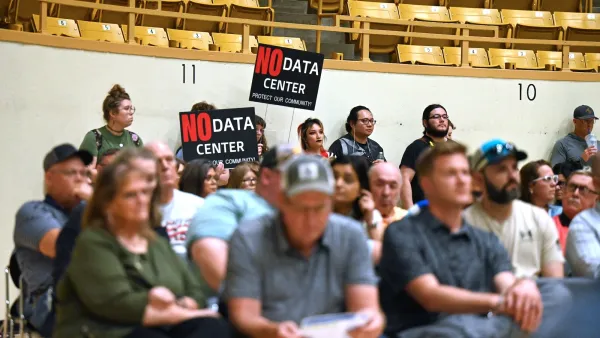
Poll: 75% of Americans oppose data centers near their homes
As they proliferate across the country, data centers face growing backlash from communities concerned about their rapid growth and unknown impacts.
Seattle bans data centers for a year
The city council approved the measure after five 'mystery' projects raised concerns among residents and city leaders.
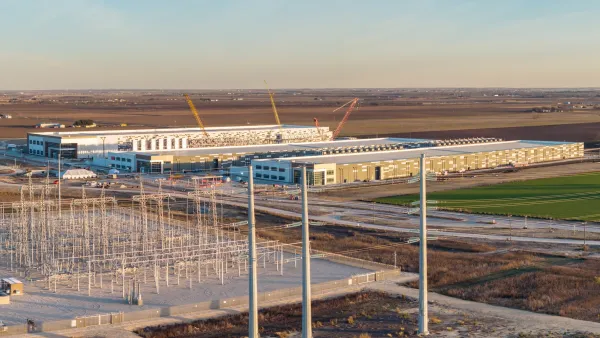
Texas bars data centers from raising utility costs for residents
Gov. Abbott is calling on the state's utility regulator to take steps to reduce energy costs for consumers and ensure data center operators pay for any added costs.

Planetizen Federal Action Tracker
A weekly monitor of how Trump’s orders and actions are impacting planners and planning in America.

The state-sanctioned urbicide of Austin
People don’t kill cities. Freeways do.

US to reduce Colorado River water deliveries to Mexico
A new Colorado Treaty amendment reduces Mexico’s Colorado River water allocation by 250,000 acre feet.

Nation's most wind-powered state turns to coal as data centers increase energy demand
For the first time in decades, Iowa has increased its generation of coal power.

NYC cools commuters with city's first rain garden above a bus stop
New York City officials say the plants in the rain garden can absorb 16 gallons of rainwater during heavy storms.

Brightline West’s future may rely on $6 billion federal loan
The company has until Nov. 2 to make a $400 million equity investment into its proposed high-speed rail line.

FREE Course: Walkable City 1: Why Walkability?
After describing his path towards focusing on walkability as the essence of good planning, Jeff Speck marches through his five principal reasons for making more walkable places.
Reinventing Malls: Planning Alchemy—Turning Gray Fields Into Gold
The course focuses on the opportunities and imperatives that shape reinvention of mall sites.

Eagle County Government
Harvard University Graduate School of Design
Nashville Planning Department
The Architects Foundation
University of Cincinnati Online
The Pocatello Development Authority
The Urban Renewal Agency of the City of Pocatello
Journal of the American Planning Association