Companies are pressing ahead to develop emerging technologies, like fusion reactors and small modular units.


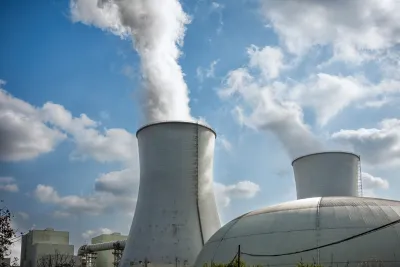
This article by John Stang was originally published in the Washington State Standard. It has been shortened. It is republished under Creative Commons license CC BY-NC-ND 4.0.
Washington spent much of the 1970s trying to become a center for nuclear power, with plans for five huge fission reactors at Richland and Satsop.
Fast forward to today.
Again, Washington is trying to become a hub for nuclear power. But instead of monster-size reactors, the state is now home to multiple ventures involving smaller reactors — all using technologies unheard of in the 1970s and 1980s.
One of the first commercially viable fusion reactors in the U.S. is under construction roughly 6 miles southeast of Wenatchee. It’s expected to be working by 2028, with power going to Microsoft.
Efforts are also underway to develop a different type of fusion reactor in Everett and Richland. These would be small portable units.
Two Republican Washington state legislators — with high-ranking Democratic cosponsors — have introduced similar 2026 nuclear fission power reactor bills in the Senate and House.
The bills, which do not mention fusion power, call for developing a nuclear power development master plan for Washington state by Dec. 15, 2026.
FULL STORY: Nuclear power ventures heat up around Washington state

South Carolinians Still on the Hook for Failed Nuclear Plants
“It has to be one of the greatest wastes of money in any state’s history,” Alan Greenblatt writes.
What data center host communities can learn from former nuclear hubs
The sometimes painful process of decommissioning former nuclear facilities offers useful lessons for communities planning to host data centers.
New York, New Jersey Approve Key Permits for Trump-Backed Natural Gas Pipeline
The proposed Northeast Supply Enhancement pipeline would run for 25 miles, including 17 miles underwater near Staten Island.

Planetizen Federal Action Tracker
A weekly monitor of how Trump’s orders and actions are impacting planners and planning in America.

The state-sanctioned urbicide of Austin
People don’t kill cities. Freeways do.

US to reduce Colorado River water deliveries to Mexico
A new Colorado Treaty amendment reduces Mexico’s Colorado River water allocation by 250,000 acre feet.

5 New England states march closer to 800 megawatt wind energy project
Securing federal approval for the project may be complicated under the Trump administration, which has historically been hostile towards domestic wind power.

Baltimore to break ground on $50 million Transit Priority Project
The project will bring faster bus trips, safer streets and better bike connections to Baltimore.

Airbnb launches $250 million 'last-dollar financing' housing accelerator, makes first investment in Austin
The company will put $6.4 million towards affordable housing development in Texas’ capital.

FREE Course: Walkable City 1: Why Walkability?
After describing his path towards focusing on walkability as the essence of good planning, Jeff Speck marches through his five principal reasons for making more walkable places.
Reinventing Malls: Planning Alchemy—Turning Gray Fields Into Gold
The course focuses on the opportunities and imperatives that shape reinvention of mall sites.

Eagle County Government
Harvard University Graduate School of Design
Nashville Planning Department
The Architects Foundation
University of Cincinnati Online
The Pocatello Development Authority
The Urban Renewal Agency of the City of Pocatello
Journal of the American Planning Association