The tax on property sales above $5 million has brought in less revenue last year than experts projected, but the measure could still become a significant contributor to affordable housing funds.



A so-called ‘mansion tax’ in Los Angeles that taxes land transactions over $5 million to raise funds for affordable housing and other housing programs has brought in less revenue than expected, reports Sarah Holder in Bloomberg CityLab.
According to Holder, Measure ULA has brought in just $142 million, short of the $900 million in annual projected revenue. “As the housing market stabilizes, the real estate industry adapts, and various lawsuits move through the appeals process, advocates say the tax will prove its worth. By November, monthly sales over $5 million had nearly tripled since cratering in April, bringing in nearly $14 million for Measure ULA.”
Holder notes that “Although single-family homes represent the largest share of its projected revenue at 38%, the tax also applies to most multifamily developments, office buildings and hotels.” Some developers say this will hamstring the construction of multifamily apartment buildings, including affordable housing. “A 2022 UCLA study somewhat assuaged concerns about affordable housing, suggesting that the tax would have little impact on multifamily construction, in part because developers rarely sell their properties right after building them.”
Despite the backlash, “Already, 19 affordable housing projects with a total of 1,500 units have applied for a piece of the $56.8 million in Measure ULA funding available. Short-term rental assistance has started going out to tenants and landlords.” And other cities are proposing their own mansion taxes, including Santa Fe, Chicago, and Seattle.
Read the full story: As ‘Mansion Taxes’ Catch On in US Cities, Los Angeles Offers Lessons


New Los Angeles Rent Relief Program Targets Pandemic Debt
The program prioritizes the lowest-income tenants who accrued debt during the early part of the pandemic.
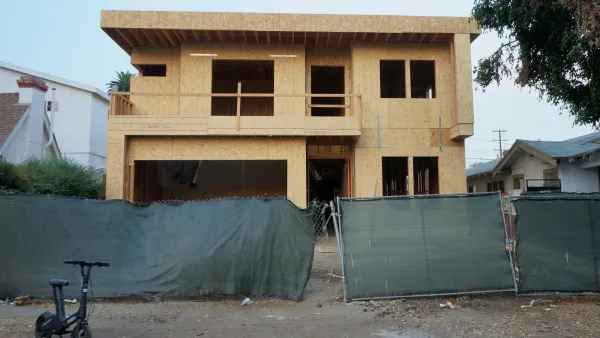
Report: LA Construction Permits Fell 40% After ‘Mansion Tax’
New housing permits fell sharply for both single-family homes and multifamily buildings after the city enacted a tax on property sales over $5 million.

L.A. Councilmember Proposes Social Housing Model
Inspired by the success of Vienna, Austria, Los Angeles leaders are considering public housing as a faster, more effective way to curb the city’s homelessness crisis.

Planetizen Federal Action Tracker
A weekly monitor of how Trump’s orders and actions are impacting planners and planning in America.

Data reveals that NYC’s bet on congestion pricing has paid off
After almost two years of the program, reports show positive impacts on traffic and air quality and no disruptions to parking.

Denver is solving homelessness. Why aren't the rest of us?
Since 2023, Denver's street homeless population has decreased by 64%, proving that effective tools exist to support those in need of housing.

CA city to shut down airport, transform it into utopian park
The western side of the 200-acre park will feature a dog park, nature education center and arboretum.

NYC to vote on supporting outdoor dining, streamlining bus and bike lane creation
The city has five proposed amendments to its municipal constitution on the ballot this November.

Chicago breaks ground on $3 billion megadevelopment
The new neighborhood, titled Foundry Park, will one day host 3,700 residences.

FREE Course: Walkable City 1: Why Walkability?
After describing his path towards focusing on walkability as the essence of good planning, Jeff Speck marches through his five principal reasons for making more walkable places.
Reinventing Malls: Planning Alchemy—Turning Gray Fields Into Gold
The course focuses on the opportunities and imperatives that shape reinvention of mall sites.

City of Rosemead
Rutgers University, Edward J. Bloustein School of Planning and Public Policy
One Hundred Miles
The Architects Foundation
University of Cincinnati Online
Montrose County
Northern Illinois Transit Authority (NITA)
The Pocatello Development Authority