The theme park giant is one step closer to adding new sections to its Anaheim empire.


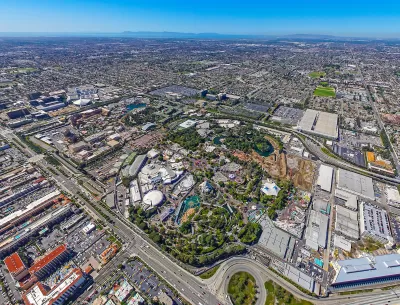
Writing in The Mercury News, Brady MacDonald describes the environmental impact study released by the city of Anaheim as it weighs approvals for an expansion of the Disneyland parks. The two sites, one located on a former strawberry farm-turned-Disney parking lot, would remain within the company’s existing 500-acre property. “The DisneylandForward plan envisions two pedestrian bridges over Disneyland Drive and up to three over Harbor Boulevard that would connect to a 17,000-space eastside garage along Disney Way that would be the world’s largest parking structure.”
The study reveals that the biggest impacts would come from air quality, greenhouse gas emissions, and noise. “Air quality would be significantly and unavoidably impacted during the construction phase and park operations of any Disneyland Forward project, according to the EIR.” Required mitigation measures would include sound buffers, water conservation measures, and energy efficiency initiatives.
MacDonald adds, “Transportation and traffic were not considered major issues in the EIR in part because Disneyland, Caltrans and Anaheim overbuilt resort area streets, intersections, freeways and interchanges in recent years.
FULL STORY: Disneyland theme park expansion moves one step closer with impact study


Friday Eye Candy: Renderings for the New Star Wars Theme Park
Fans of Disney theme parks and fans of Star Wars had a big week.

Disney's Political Donations Increase as Anaheim Considers a Streetcar
Disney says its supports pro-business candidates for City Council in Anaheim, but some see a proposed streetcar as the connection behind an uptick in the company's local political support.

Disneyland's Autopia finally goes electric (sort of)
Today, the 'futuristic' ride still spews out gas fumes. Disney says it is testing new electric prototypes.

Planetizen Federal Action Tracker
A weekly monitor of how Trump’s orders and actions are impacting planners and planning in America.

The state-sanctioned urbicide of Austin
People don’t kill cities. Freeways do.

US to reduce Colorado River water deliveries to Mexico
A new Colorado Treaty amendment reduces Mexico’s Colorado River water allocation by 250,000 acre feet.

5 New England states march closer to 800 megawatt wind energy project
Securing federal approval for the project may be complicated under the Trump administration, which has historically been hostile towards domestic wind power.

Baltimore to break ground on $50 million Transit Priority Project
The project will bring faster bus trips, safer streets and better bike connections to Baltimore.

Airbnb launches $250 million 'last-dollar financing' housing accelerator, makes first investment in Austin
The company will put $6.4 million towards affordable housing development in Texas’ capital.

FREE Course: Walkable City 1: Why Walkability?
After describing his path towards focusing on walkability as the essence of good planning, Jeff Speck marches through his five principal reasons for making more walkable places.
Reinventing Malls: Planning Alchemy—Turning Gray Fields Into Gold
The course focuses on the opportunities and imperatives that shape reinvention of mall sites.

Eagle County Government
Harvard University Graduate School of Design
Nashville Planning Department
The Architects Foundation
University of Cincinnati Online
The Pocatello Development Authority
The Urban Renewal Agency of the City of Pocatello
Journal of the American Planning Association