Dual, cooperating studies are underway in Cleveland to reimagine the connections between the city's downtown and lakefront.


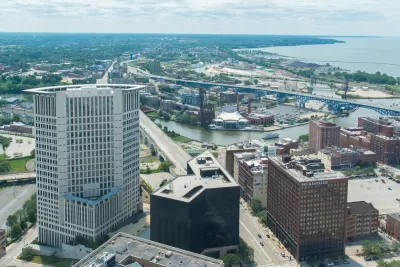
Cleveland recently launched a master planning process to revitalize its lakefront, when Mayor Justin Bibb announced a request for proposals for a $500,000 contract that builds on an earlier proposal made by the owners of the Cleveland Browns.
In an article for Cleveland.com, Steven Litt credits a May 2021 proposal by Jimmy and Dee Haslam for jumpstarting the conversation that led to the new master planning process, although there has been a long track record of revitalization plans proposed for linking Cleveland’s downtown core and the lakefront, such as a proposal for an intermodal transit facility picked up by Planetizen in October 2015. Downtown Cleveland and the Lake Erie waterfront are currently “separated by a bleak, 14-acre landscape of concrete and steel,” writes Litt.
“The Haslam concept sparked a $5 million transportation feasibility analysis, funded 50-50 by the city and the Ohio Department of Transportation, that started earlier this year. The feasibility study is aimed at clarifying the impact on local and regional traffic if the Shoreway were altered in order to enable the Mall extension,” adds Litt.
Mayor Bibb’s contract would expend the purview of the city’s studies beyond traffic impacts, however, and in a much larger portion of the city. “The new study area will extend from the Warehouse District on the west to East 18th Street on the east, and the city’s municipal parking lots along South Marginal Road,” writes Litt.
City officials hope to use the two studies in concert to pursue federal funding opportunities, through the Infrastructure Investment and Jobs Act, in 2024.
Read the full story: City of Cleveland seeking consultants for new downtown lakefront master plan with broader scope than Haslam proposal


Parking Requirements Removed Near Cleveland Transit Stops
Transit oriented parking reform has arrived in Cleveland.
Political Support for Amtrak’s All Aboard Ohio Plans Follows Federal Infrastructure Funding
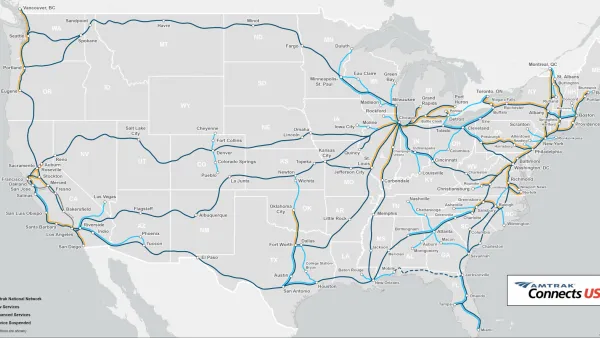
Gov. Mike DeWine’s sudden interest in working with Amtrak might have something to do with $66 billion in Infrastructure Investment and Jobs Act funding recently announced by the Federal Railroad Administration.
Ohio Plans for $1.3 Billion Federal Transit Investment
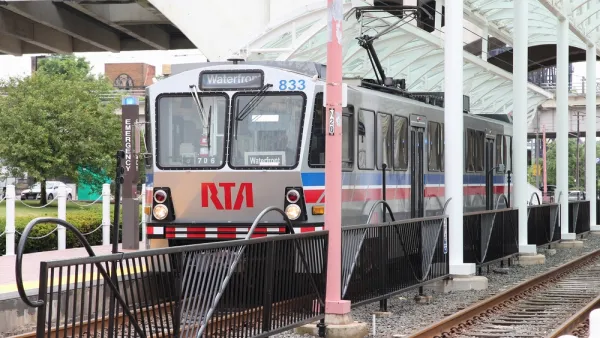
Ohio lawmakers say new federal funding will help the state improve public transit systems, hire more operators, and make badly needed facility and equipment upgrades.

Planetizen Federal Action Tracker
A weekly monitor of how Trump’s orders and actions are impacting planners and planning in America.

The state-sanctioned urbicide of Austin
People don’t kill cities. Freeways do.

US to reduce Colorado River water deliveries to Mexico
A new Colorado Treaty amendment reduces Mexico’s Colorado River water allocation by 250,000 acre feet.

Nation's most wind-powered state turns to coal as data centers increase energy demand
For the first time in decades, Iowa has increased its generation of coal power.

NYC cools commuters with city's first rain garden above a bus stop
New York City officials say the plants in the rain garden can absorb 16 gallons of rainwater during heavy storms.

Brightline West’s future may rely on $6 billion federal loan
The company has until Nov. 2 to make a $400 million equity investment into its proposed high-speed rail line.

FREE Course: Walkable City 1: Why Walkability?
After describing his path towards focusing on walkability as the essence of good planning, Jeff Speck marches through his five principal reasons for making more walkable places.
Reinventing Malls: Planning Alchemy—Turning Gray Fields Into Gold
The course focuses on the opportunities and imperatives that shape reinvention of mall sites.

Greater Baltimore Committee
Eagle County Government
Harvard University Graduate School of Design
The Architects Foundation
University of Cincinnati Online
The Pocatello Development Authority
The Urban Renewal Agency of the City of Pocatello
Journal of the American Planning Association