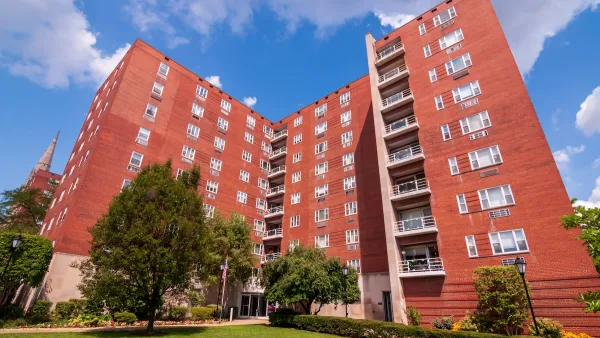
The mutual housing developments known as limited-equity cooperatives give lower-income residents an opportunity to buy into a building where they could not otherwise afford it.



The city of Pittsburgh is evaluating the potential of mutual housing developments as a tool for boosting affordable housing, reports Hallie Lauer. “The developments — referred to as limited-equity cooperatives — are an affordable housing tool where the building is owned collectively by the residents, but buy-ins are offered at below market prices and are for low income residents.”
“To fully understand the role of LECs in affordable housing, council is asking that the city’s planning department and Department of Permits, Licenses and Inspections prepare a report regarding limited-equity cooperatives that are in the city.” The City Council wants to know how many of these developments currently exist, their regulations, and how they are structured. “It is also looking for recommendations that could increase the number of these buildings like incentivizing them by waiving permit fees or funding options to build new LECs.” The Council is also looking to existing LEC regulations in other cities as models for Pittsburgh.
Read the full story: Pittsburgh City Council to explore alternative ways to promote affordable housing

Pittsburgh Lawsuit Threatens Affordable Housing Requirement
A suit brought by a developers’ group calls the cost burden of the city’s inclusionary zoning law ‘unconstitutional.’

Defunct Pittsburgh Power Plant to Become Residential Tower
A decommissioned steam heat plant will be redeveloped into almost 100 affordable housing units.

Pittsburgh Mayor Proposes Zoning Changes to Curb Housing Shortage
The mayor’s plan includes legalizing ADUs in single-family neighborhoods, eliminating parking requirements, and adding new affordability requirements to buildings with over 20 units.

Planetizen Federal Action Tracker
A weekly monitor of how Trump’s orders and actions are impacting planners and planning in America.

Amtrak, CN end decades-long dispute with eight-year agreement
The new operating agreement establishes an updated framework for the companies to work together, including processes to resolve disputes.

Colorado’s Largest Data Center Could Rise Next to Homes — Without a Public Hearing
The proposed campus would consume 11 times the power of Denver International Airport; as it has across the country, opposition mounts.

'This is going to be painful:’ Virginia stares down $1.7 billion funding gap for highway maintenance
The state may address the deficit by shifting $290 million from its construction budget to maintenance projects.

Judges permit Denver to divert 77,000 acre feet from the Colorado River for reservoir expansion
Overuse and climate change have caused the Colorado River’s water levels to plummet.

Amtrak, CN end decades-long dispute with eight-year agreement
The new operating agreement establishes an updated framework for the companies to work together, including processes to resolve disputes.

FREE Course: Walkable City 1: Why Walkability?
After describing his path towards focusing on walkability as the essence of good planning, Jeff Speck marches through his five principal reasons for making more walkable places.
Reinventing Malls: Planning Alchemy—Turning Gray Fields Into Gold
The course focuses on the opportunities and imperatives that shape reinvention of mall sites.

KFH Group Inc.
Greater Baltimore Committee
Eagle County Government
The Architects Foundation
University of Cincinnati Online
The Pocatello Development Authority
The Urban Renewal Agency of the City of Pocatello