The Community First Village, which offers homes and supportive services for people experiencing homelessness, is adding 127 acres to a 27-acre site.


Austin-based nonprofit group Mobile Loaves and Fishes recently announced plans to quadruple the size of the Community First Village, a tiny home village opened in 2015.
Community First Village "offers supportive housing in the form of mobile homes, tiny houses, gardens, community space, and services for people who have been unhoused on an ongoing basis," explains Cindy Widner in an article for Urbanize Austin (additional local news coverage is available for those paying for a subscription to the Austin American-Statesman).
Mobile Loaves and Fishes has acquired an additional 127 acres of land to expand the previously 27-acre site located a few miles east of downtown Austin. "The addition will allow it to expand its original site as well as creating a new village in Southeast Austin. CF plans to add 1,400 homes on the two sites at an expected cost of $119 million. MLF plans to launch a fundraising campaign for the expansion this fall," reports Widner.
Read the full story: Tiny home community in East Austin set to expand

Ann Arbor millage tax has created over $27M for affordable housing
The 2020 property tax is expected to fund roughly 1,500 new affordable homes.
Seattle mayor pledges to build 500 shelter units by June
The Seattle Times editorial board expresses cautious optimism about the mayor's ambitious supportive housing plan.
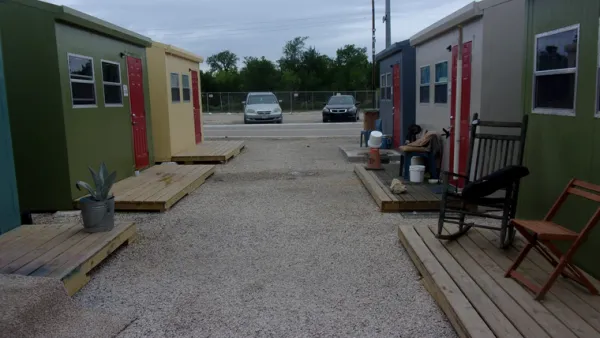
Austin Approves Over $10 Million for Homelessness Programs
The funding package supports emergency shelters totaling close to 500 beds.

Planetizen Federal Action Tracker
A weekly monitor of how Trump’s orders and actions are impacting planners and planning in America.

The state-sanctioned urbicide of Austin
People don’t kill cities. Freeways do.

US to reduce Colorado River water deliveries to Mexico
A new Colorado Treaty amendment reduces Mexico’s Colorado River water allocation by 250,000 acre feet.

Nation's most wind-powered state turns to coal as data centers increase energy demand
For the first time in decades, Iowa has increased its generation of coal power.

NYC cools commuters with city's first rain garden above a bus stop
New York City officials say the plants in the rain garden can absorb 16 gallons of rainwater during heavy storms.

Brightline West’s future may rely on $6 billion federal loan
The company has until Nov. 2 to make a $400 million equity investment into its proposed high-speed rail line.

FREE Course: Walkable City 1: Why Walkability?
After describing his path towards focusing on walkability as the essence of good planning, Jeff Speck marches through his five principal reasons for making more walkable places.
Reinventing Malls: Planning Alchemy—Turning Gray Fields Into Gold
The course focuses on the opportunities and imperatives that shape reinvention of mall sites.

Eagle County Government
Harvard University Graduate School of Design
Nashville Planning Department
The Architects Foundation
University of Cincinnati Online
The Pocatello Development Authority
The Urban Renewal Agency of the City of Pocatello
Journal of the American Planning Association