A new study says that huge amounts of water are moved from rural areas to cities to support rapidly growing urban populations.


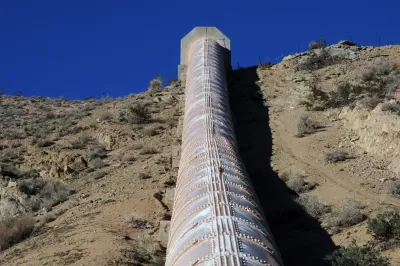
Water reallocation projects are diverting 16 billion cubic meters of water from rural areas to cities each year, according to new paper in the journal Environmental Research Letters. The problem will only grow since United Nations predictions show 2.5 billion people are expected to move to cities by 2050.
The study analyzed urban areas and reallocation projects around the world, with the majority in North America and Asia, and finds that urbanization is increasing competition between cities and agricultural areas. "Dr. [Dustin] Garrick said the world was ‘woefully underprepared’ due to a lack of data, particularly in South America and Africa."
Rural areas were most often the losers in reallocation projects, but planning has helped to mitigate outcomes. "The Mexican city of Monterrey, for example, provided farmers with compensation and city wastewater for irrigation, after diverting water from a tributary of the Rio Grande river in the 1990s, Dr. Garrick said."
FULL STORY: Cities are sucking our countryside dry, scientists say

When Cities Prosper, Rural Areas Are Better Off
The pitting of cities and rural communities against one another is the wrong approach. Instead, policies that help cities thrive will benefit rural areas in the long run.

Mourning the Loss of the Dairy Queen in Rural Texas
As populations shrink, small towns are losing an important place to get together,,

China's Urbanization Boom May Be Slowing
After a period of modernization and urban growth unrivaled in human history, several forces promise a slump, or at least a slowing. Maybe it's time to improve existing cities, not keep building new ones.

Planetizen Federal Action Tracker
A weekly monitor of how Trump’s orders and actions are impacting planners and planning in America.

The state-sanctioned urbicide of Austin
People don’t kill cities. Freeways do.

US to reduce Colorado River water deliveries to Mexico
A new Colorado Treaty amendment reduces Mexico’s Colorado River water allocation by 250,000 acre feet.

5 New England states march closer to 800 megawatt wind energy project
Securing federal approval for the project may be complicated under the Trump administration, which has historically been hostile towards domestic wind power.

Baltimore to break ground on $50 million Transit Priority Project
The project will bring faster bus trips, safer streets and better bike connections to Baltimore.

Airbnb launches $250 million 'last-dollar financing' housing accelerator, makes first investment in Austin
The company will put $6.4 million towards affordable housing development in Texas’ capital.

FREE Course: Walkable City 1: Why Walkability?
After describing his path towards focusing on walkability as the essence of good planning, Jeff Speck marches through his five principal reasons for making more walkable places.
Reinventing Malls: Planning Alchemy—Turning Gray Fields Into Gold
The course focuses on the opportunities and imperatives that shape reinvention of mall sites.

Eagle County Government
Harvard University Graduate School of Design
Nashville Planning Department
The Architects Foundation
University of Cincinnati Online
The Pocatello Development Authority
The Urban Renewal Agency of the City of Pocatello
Journal of the American Planning Association