Changes to the Mortgage Interest Deduction ostensibly made the housing subsidy more progressive. The real consequences of the change, however, make the deduction "significantly more inequitable that it was in years past."



One of the most consequential changes included in the GOP tax reform bill signed by President Trump at the end of 2017 targeted the Mortgage Interest Deduction.
Writing for Greater Greater Washington, David Meni explains the consequences of the change for tax revenue and the demographics of the Mortgage Interest Deduction:
A recent report by the Joint Committee on Taxation (a non-partisan arm of Congress, like the Congressional Budget Office) shows that while the recent tax bill will shrink the MID considerably, it also will cause the program to give even an even larger share to the wealthiest homeowners.
The cause of this regressive shift of the deduction's benefit is because so many more middle class taxpayers will shift to the standard deduction. "Last year, about 4% of the MID went to households making more than $1 million a year. With the changes to the rest of the tax code, those households now take close to 10% of the deduction," according to Meni.
FULL STORY: Surprise! The Mortgage Interest Deduction is now even more of a handout to the wealthy

Analysis: ROAD to Housing Act could take years to implement
HUD is tasked with implementing nine new rules as part of the ROAD to Housing Act — while operating with a significantly reduced staff.

ROAD to Housing Act passes into law without president's signature
President Trump did not sign or veto the bill, letting it pass into law early Saturday.
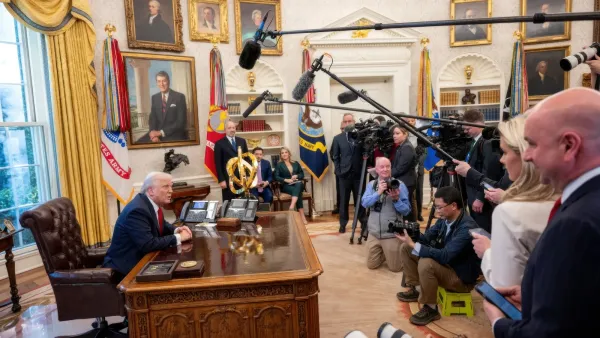
Trump refuses to sign housing bill, throwing bipartisan agreement into limbo
The president's cancellation of the bill signing came as a shock to both sides of the political aisle.

Planetizen Federal Action Tracker
A weekly monitor of how Trump’s orders and actions are impacting planners and planning in America.

The state-sanctioned urbicide of Austin
People don’t kill cities. Freeways do.

US to reduce Colorado River water deliveries to Mexico
A new Colorado Treaty amendment reduces Mexico’s Colorado River water allocation by 250,000 acre feet.

Baltimore to break ground on $50 million Transit Priority Project
The project will bring faster bus trips, safer streets and better bike connections to Baltimore.

Airbnb launches $250 million 'last-dollar financing' housing accelerator, makes first investment in Austin
The company will put $6.4 million towards affordable housing development in Texas’ capital.

Guerilla urbanists are building DIY bus stop benches in Chicago
A before-and-after of one of the bus stops with a new bench. The new benches are not officially sanctioned or permitted, but the residents who placed them hope they will be the start of a network of DIY benches across the city.

FREE Course: Walkable City 1: Why Walkability?
After describing his path towards focusing on walkability as the essence of good planning, Jeff Speck marches through his five principal reasons for making more walkable places.
Reinventing Malls: Planning Alchemy—Turning Gray Fields Into Gold
The course focuses on the opportunities and imperatives that shape reinvention of mall sites.

Eagle County Government
Harvard University Graduate School of Design
Nashville Planning Department
The Architects Foundation
University of Cincinnati Online
The Pocatello Development Authority
The Urban Renewal Agency of the City of Pocatello
Journal of the American Planning Association