The annual "50-State Property Tax Comparison Study" is available examines the imbalances across jurisdictions, and even within jurisdictions, when it comes to property taxes.


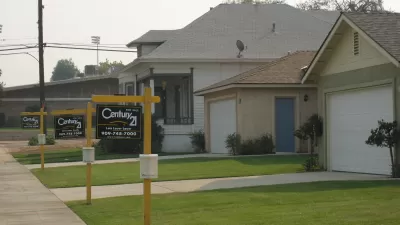
The Lincoln Institute of Land Policy and the Minnesota Center for Fiscal Excellence have released the latest version of the annual 50-State Property Tax Comparison Study.
A blog post announcing the new study focuses on the discrepancies in property tax rates that can arise parcel to parcel in cities like Los Angeles, where proposition 13 can mean one house pays twice as much in property taxes as the house next door. "Of the ten American cities with the greatest discrepancy in taxes paid by new homeowners and longtime homeowners, six are in California and two are in Florida, where the 1992 Save Our Homes constitutional amendment similarly restricts reassessment," according to the post.
The report analyses effective property tax rates—"the tax paid as a percentage of market value"—in 100 cities located in every state. As in previous years, the report also lists the cities with the highest and lowest effective property tax rates.
Read the full story: Why identical homes can have different property tax bills


Signatures Submitted for Initiative to Reform California Proposition 13
A coalition of groups advocating for more funding for local communities and schools want to reform the landmark tax-cutting initiative by treating commercial and industrial properties different than residential, creating the so-called "split roll."
Comparing the Differences in Property Taxes Around the United States
The Lincoln Institute of Land Policy and the Minnesota Center for Fiscal Excellence have released their annual "50-State Property Tax Comparison Study."

Comparing Property Tax Rates for 100 U.S. Cities
The Lincoln Institute of Land Policy has released its annual comparison of property tax rates around the country, adding new wrinkles of analysis for this year's edition.

Planetizen Federal Action Tracker
A weekly monitor of how Trump’s orders and actions are impacting planners and planning in America.

California plans to bury El Niño’s downpour
If the state plays its cards right, it may be able to store a billion acre-feet of El Niño’s water in aquifers.

Chicago breaks ground on $3 billion megadevelopment
The new neighborhood, titled Foundry Park, will one day host 3,700 residences.

California High-Speed Rail Authority CEO resigns after $600,000 scandal
Under Ian Choudri, the authority used taxpayer dollars to fund first class flights and trips to nightclubs.

Want to study the Missouri River? Soon, you may need unanimous approval from 10 states
Legislation would require 10 governors’ permission to study or build projects moving water outside the basin.

Desperate measures: Advocates weigh draining Lake Powell to fill Colorado River
Draining the reservoir could reduce evaporation losses by a couple hundred thousand acre-feet.

FREE Course: Walkable City 1: Why Walkability?
After describing his path towards focusing on walkability as the essence of good planning, Jeff Speck marches through his five principal reasons for making more walkable places.
Reinventing Malls: Planning Alchemy—Turning Gray Fields Into Gold
The course focuses on the opportunities and imperatives that shape reinvention of mall sites.

City of Rosemead
Rutgers University, Edward J. Bloustein School of Planning and Public Policy
One Hundred Miles
Hunter College, City University of New York (CUNY)
The Architects Foundation
University of Cincinnati Online
City of Cambridge
Montrose County
The Pocatello Development Authority